Cryogenic labels rely on specialized materials and adhesives to survive extremely cold storage environments. Laboratories use these labels to identify samples stored in ultra-low freezers, dry ice, and liquid nitrogen systems where ordinary labels quickly fail. Durable cryogenic labels must resist moisture, handling, and temperature changes while remaining readable and securely attached.
Cryogenic label materials and adhesives play a critical role in this performance. Durable labels provide strength and flexibility in cold environments, while carefully selected cryogenic label adhesives maintain adhesion when temperatures drop far below standard freezer conditions.
Laboratories store samples in a wide range of environments, from standard laboratory freezers to ultra-low freezers and cryogenic storage systems. Each environment places different stresses on a label. Understanding how cryogenic label materials and adhesives behave under these conditions helps laboratories choose durable cryogenic labels that maintain reliable sample identification throughout storage and handling.
This guide explains how cryogenic label materials and cryogenic label adhesives behave in cold storage environments and how laboratories can choose durable cryogenic labels for long-term sample identification.
Key Takeaways:
Cryogenic labels identify samples stored in extreme cold.
Storage environments range from freezers to liquid nitrogen.
Application temperature differs from operating temperature.
Frost and moisture commonly cause label adhesion failure.
Synthetic materials usually outperform paper in cryogenic environments.
Adhesive performance determines long-term label reliability.
Need cryogenic labels that survive ultra-low storage?
Explore our durable cryogenic labels designed for freezers, dry ice, and liquid nitrogen environments.
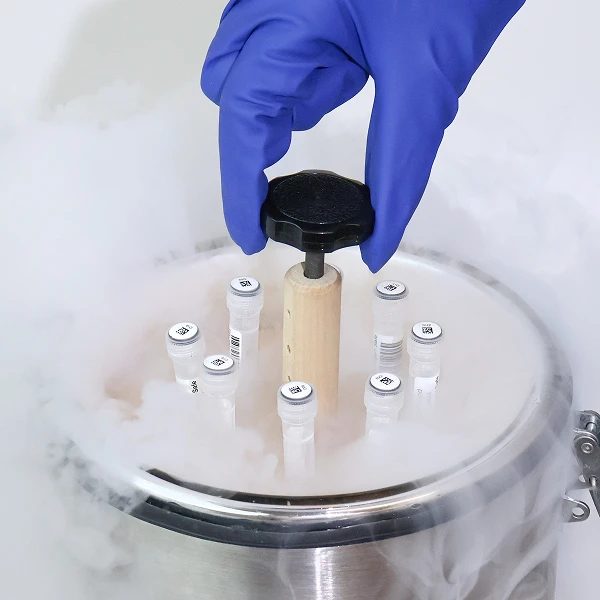
What Are Cryogenic Labels?
Cryogenic labels are pressure-sensitive identification labels designed to remain adhered and readable at extremely low temperatures, including ultra-low freezers and liquid nitrogen storage environments. Laboratories use these labels to identify tubes, vials, plates, and other labware stored in cold or cryogenic conditions.
Cryogenic sample storage may range from standard laboratory freezers to ultra-low freezers and liquid nitrogen systems, so label materials and adhesives must match the actual storage environment. A label that performs well in a −20 °C freezer may fail in a −80 °C freezer or liquid nitrogen system if it was not designed for those conditions.
Cryogenic labels typically use durable film face stocks combined with adhesives engineered for low-temperature performance. These materials help the label resist moisture, frost, and temperature fluctuations that occur during storage or sample handling.
Selecting a cryogenic label requires more than choosing a material rated for a specific temperature. Container material, handling conditions, chemicals, and labeling methods can all affect how a label performs in cryogenic environments.
Cryogenic Storage Temperatures Explained
Cryogenic labels must withstand extremely cold storage environments used in laboratory research and sample preservation. These environments range from standard laboratory freezers to liquid nitrogen systems used for long-term cryogenic storage. Each temperature range creates different challenges for cryogenic label materials and adhesives.
Laboratories often store samples across several temperature conditions depending on the type of material and the duration of storage. As temperatures drop, labels must resist increasing stress from moisture, frost, handling, and thermal contraction.
Laboratory cryogenic storage environments typically range from standard freezers to liquid nitrogen conditions approaching −196 °C.
storage environment typical temperature
Laboratory freezer
-20°C
Ultra-low freezer
-80°C
Vapor phase nitrogen
-150°C
Liquid nitrogen
-196°C
Standard laboratory freezers store many biological samples at around −20 °C. Ultra-low temperature freezers operate closer to −80 °C and support long-term preservation of sensitive biological materials. Some laboratories use vapor phase nitrogen storage around −150 °C to reduce contamination risks associated with liquid nitrogen immersion.
Liquid nitrogen storage represents the coldest common laboratory environment. Temperatures near −196 °C allow laboratories to preserve biological materials for extremely long periods, but they also place significant demands on cryogenic label materials and adhesives. Labels used in these environments must maintain adhesion, flexibility, and print readability despite extreme cold and repeated handling.
Application Temperature vs Operating Temperature
Application temperature and operating temperature describe two different stages of label performance. Understanding the difference helps laboratories choose cryogenic label materials and adhesives that perform reliably in cold storage.
A label’s application temperature describes the temperature at which it can be applied successfully, while its operating temperature describes the conditions it can withstand after proper adhesion has been achieved.
Application temperature matters because pressure-sensitive adhesives must first form a bond with the container surface. When someone applies a label, the adhesive needs enough flexibility to spread across the surface and create strong contact. If the container is too cold, the adhesive may not flow properly and the bond may never fully develop.
Operating temperature describes the environment the label experiences after it bonds. Once adhesion forms, durable cryogenic label materials and adhesives allow the label to remain readable and attached even when samples move into ultra-low freezers or cryogenic storage systems.
Allowing time for the adhesive to set—or adhesive dwell time—helps ensure the strongest possible bond before samples enter extreme cold storage.

Why Cryogenic Labels Fail
Cryogenic label failure usually occurs when label materials, adhesives, or application conditions do not match the storage environment. Extremely low temperatures place significant stress on both the label construction and the bonding process. Moisture, frost, handling, and temperature changes can all interfere with long-term adhesion and readability.
Frost and surface moisture are common causes of cryogenic label failure because the adhesive may bond to the frost layer instead of the container itself. When a technician applies a label to a frosted tube or vial, the adhesive may attach to the thin ice layer rather than the container surface. As the frost melts or shifts during handling, the bond weakens and the label can lift or fall off.
Condensation creates similar problems. When containers move between temperature environments, moisture can form on the surface and prevent the adhesive from making full contact with the container. If the adhesive cannot fully wet the surface, the label may never develop a strong bond.
Using the wrong adhesive for the storage environment can also lead to failure. Adhesives designed for room temperature applications often become brittle or lose tack in extremely cold conditions. Cryogenic label adhesives must remain flexible and maintain adhesion even as temperatures drop far below standard freezer ranges.
Label material also plays an important role. Standard paper labels often absorb moisture and weaken in cold environments, while durable film materials maintain flexibility and resist cracking during freeze-thaw cycles.
Even when the correct materials and adhesives are used, application conditions still matter.
Even when a label is designed for cold environments, a dry and frost-free surface is often critical for achieving the strongest possible bond.
Preparing containers properly, selecting cryogenic label materials designed for the storage temperature, and using adhesives formulated for low-temperature performance all help reduce the risk of label failure in cryogenic environments.
How to Label Frozen Tubes
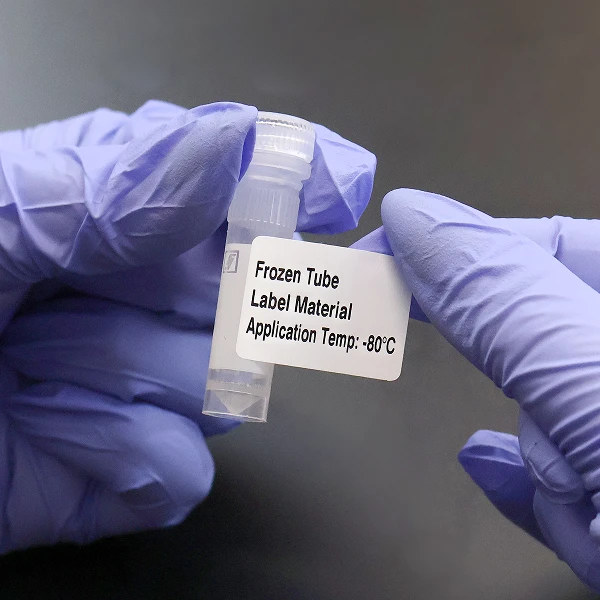
Applying labels to frozen tubes or containers presents additional challenges for cryogenic labeling. Many pressure-sensitive adhesives require warmer application conditions so they can properly bond to the surface. When a container is already frozen, the adhesive may struggle to spread and create strong contact.
In some situations, laboratories remove frost and briefly warm the surface before applying the label. This allows the adhesive to wet the container surface and begin forming a strong bond before the sample returns to cold storage.
Specialized cryogenic label adhesives can sometimes adhere to frozen surfaces, but frost and moisture still reduce adhesion if they remain on the container.
For best results, technicians should wipe away visible frost and apply labels to the cleanest, driest surface possible.
Because frozen-surface labeling involves additional variables, laboratories often rely on labels specifically designed for that environment. A more detailed guide to labeling frozen tubes is available in our article on how to label frozen samples in cold storage.
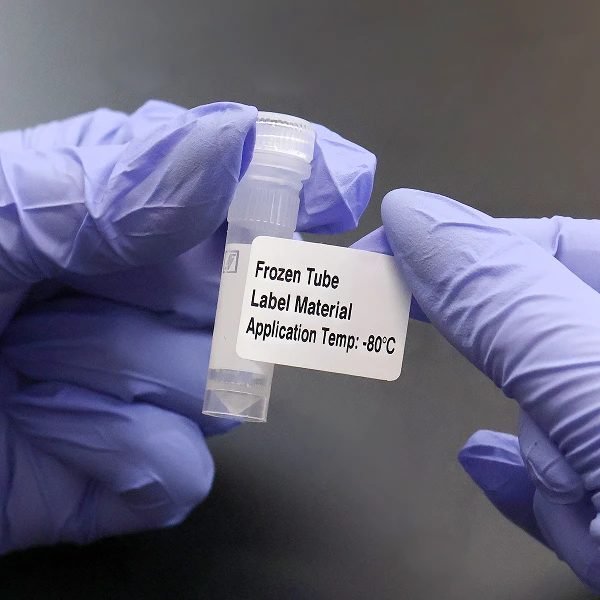
Cryogenic Label Materials
Cryogenic label materials must withstand extreme temperatures, moisture exposure, and repeated handling without losing readability or structural integrity. These conditions place significant demands on the label face stock, which must remain stable and flexible even in ultra-low temperature environments.
Cryogenic labels often use durable film face stocks rather than paper because film materials are generally better suited to moisture, handling, and extreme temperature exposure.
Paper labels rarely perform well in cryogenic environments. Paper can absorb moisture and become brittle as temperatures drop, which increases the risk of tearing, curling, or image damage during handling. For this reason, most durable cryogenic labels use film materials engineered to maintain strength and flexibility in cold storage.
Several material characteristics influence how well a label performs in cryogenic environments.
Dimensional stability is one of the most important properties. As temperatures change, some materials expand or contract. A cryogenic label material must maintain its shape and size to keep barcodes readable and prevent the label from lifting at the edges.
Flexibility and conformability also play a major role. Many laboratory containers have curved surfaces, such as tubes or small vials. A flexible material can conform to these shapes and maintain contact with the container even as temperatures fluctuate.
Material thickness can affect durability and application performance. Thinner films often conform more easily to small-diameter tubes and curved labware, while thicker constructions may provide additional durability or resistance to handling damage. Choosing the right thickness depends on the container type and application method.
Moisture and chemical resistance also matter in cryogenic environments. Labels may encounter frost, condensation, laboratory reagents, or cleaning chemicals during normal workflows. Film materials typically resist these exposures better than paper constructions.
Common film materials used for cryogenic labels include polyester, polypropylene, and polyethylene. Each material offers different performance characteristics depending on the storage environment and application.
material
key characteristics
cryogenic use
Polyester
Excellent dimensional stability and durability
Long-term sample identification
Polypropylene
Flexible and moisture-resistant
Tube and vial labeling
Polyethylene
Highly conformable for small containers
Small vials and curved labware
Selecting the right cryogenic label material requires balancing several factors, including temperature exposure, container shape, handling conditions, and printing requirements. Matching the material to the application helps ensure labels remain legible and securely attached throughout cryogenic storage and laboratory workflows.
Need to test cryogenic label materials in your lab?
Request sample labels to evaluate performance in your storage conditions.

Cryogenic Label Adhesives
Adhesives play a critical role in cryogenic label performance. While the face material provides durability and flexibility, the adhesive ultimately determines whether the label remains securely attached throughout storage and handling.
Adhesive selection is just as important as face stock selection in cryogenic labeling, because low-temperature performance depends on how well the adhesive can wet the surface, build bond strength, and remain stable in use.
Pressure-sensitive adhesives form bonds through surface contact rather than chemical curing. When someone applies a label, the adhesive spreads across the container surface and creates a bond through physical contact. This process depends on the adhesive’s ability to flow and conform to microscopic surface irregularities on the container surface.
Two adhesive families commonly appear in cryogenic labels: acrylic adhesives and rubber-based adhesives. Each offers different performance characteristics depending on the application.
Acrylic adhesives often provide strong long-term durability in demanding environments. They typically resist moisture, chemicals, and temperature changes, which makes them well suited for laboratory identification applications where labels must remain intact over extended storage periods.
Rubber-based adhesives often provide higher initial tack. This stronger immediate adhesion can help labels bond quickly to small containers, curved surfaces, or difficult plastics where achieving full surface contact can be challenging.
Several adhesive properties influence cryogenic label performance.
adhesive property
what it measures
cryogenic impact
Tack
Initial stickiness during application
Helps labels grab the container quickly
Peel Strength
Resistance to winging and edge lift
Helps prevent labels from falling off during handling
Shear Strength
Resistance to sliding under stress
Helps labels stay in place during storage
Low-Temperature Flexibility
Ability to remain soft in cold environments
Prevents brittleness and cracking
Low-temperature flexibility is particularly important. As temperatures drop, some adhesives can stiffen or lose their ability to maintain surface contact. Cryogenic label adhesives must remain flexible enough to maintain adhesion as containers expand or contract during temperature changes.
Surface compatibility also affects adhesive performance. Laboratory containers often use plastics such as polypropylene or polyethylene, which have relatively low surface energy. Adhesives designed for these substrates improve bonding reliability, especially on small tubes or curved labware.
Allowing adequate dwell time after application helps adhesives develop their strongest bond. During this period, the adhesive continues to flow into microscopic surface irregularities, increasing contact area and strengthening adhesion.
Selecting the right cryogenic label adhesive requires considering storage temperature, container material, application conditions, and handling requirements. Matching the adhesive to these factors helps ensure reliable performance throughout cryogenic storage and laboratory workflows.
Choosing the Right Cryogenic Label
Selecting the right cryogenic label requires balancing several factors, including storage temperature, container material, handling conditions, and labeling workflows. While temperature often receives the most attention, many other variables influence long-term label performance.
The right cryogenic label depends on more than the lowest temperature in the process; container material, application conditions, handling, chemicals, and required print durability can all affect performance.
Container surface plays an important role. Many laboratory tubes and vials use plastics such as polypropylene or polyethylene, which have relatively low surface energy and can be difficult for adhesives to bond with. Labels designed for these substrates help improve adhesion and reliability.
Application conditions also matter. Labels applied to clean, dry surfaces typically achieve stronger bonds than those applied to frosted or wet containers. Allowing adequate dwell time before placing samples into extreme cold storage further strengthens adhesion.
Finally, laboratories must consider durability requirements. Labels may need to resist chemicals, repeated handling, scanning, and long-term storage while maintaining barcode readability and clear identification.
Understanding how cryogenic label materials and adhesives behave under these conditions helps laboratories select durable cryogenic labels that maintain reliable sample identification throughout cryogenic storage.
Next Steps for Selecting Cryogenic Labels
Choosing cryogenic label materials and adhesives often depends on the exact storage environment, container type, and laboratory workflow. If you’re evaluating options for your lab, the following resources can help you take the next step.
Connect with our labelling experts today
Blog article form
"*" indicates required fields