

Meet global hazard communication standards with ease. Protect safety and compliance using labels designed for chemical durability and clarity.
Pre-printed, blank, or hybrid label solutions
Durable materials for harsh environments
Two-color on-demand printing options
Streamline your labeling process with flexible options. Request free GHS label samples to see compliance in action.

Hazard labeling doesn’t stop at the shipping drum. Every step in the supply chain demands clear identification, from primary containers in transit to secondary bottles in storage, down to the smallest lab vials. By applying GHS labels consistently, you protect your team, improve workflow efficiency, and strengthen compliance across all environments where hazardous chemicals are handled.
GHS labels on bulk containers must survive chemicals, abrasion, and transport.
We print durable, compliant labels with tested face stocks and adhesives.
Enhance tracking and streamline distribution with barcodes, serialization, and smart print integration.
Secondary containers require clear, legible labeling for continued compliance and safety.
We provide blank, pre-printed, or hybrid solutions for flexible workplace workflows.
Boost efficiency with labels engineered for small containers and high-performance two-color printing.
Consumer-facing packaging demands professional, durable GHS labels that meet strict regulations.
We offer pre-printed solutions with advanced inks, coatings, and protective laminates.
Strengthen branding while maintaining compliance through integrated hazard communication and design.
Workplace labeling requires flexibility across diverse chemical types and environments.
We deliver solutions compatible with in-house printing or pre-printed supply chains.
Streamline operations and enhance traceability with barcodes, sequences, and durable synthetic stocks.
Labware containers demand durable, legible labeling under extreme conditions.
We supply reduced-size, chemical-resistant options tailored for tubes, vials, and plates.
Enhance lab workflows with traceable, compliant labels that protect data and safety.
Request a free GHS label sample today and see how durable, compliant labeling enhances safety, efficiency, and traceability across your workflow.
GHS labels exist to make sure chemical hazards are understood instantly, no matter where a product travels or how it is handled. They combine visual symbols, standardized wording, and supplier information into one consistent format. By requiring the same structure worldwide, GHS labels reduce confusion, improve safety, and help companies stay compliant across borders.
Receive fully finished GHS labels with pictograms, text, barcodes, and variable sequences already applied. Ideal for reducing in-house workload and ensuring consistent, professional results.
Stock durable blank labels made for GHS applications, supplied with black and red ribbons and a compatible two-color printer. Print your own labels as needed.
Have pictograms or fixed elements pre-applied, while you print barcodes, text, or other variable data. A flexible option for balancing efficiency with control.
GHS labels must remain legible through harsh handling, so the face stock is critical. We offer durable synthetics like polyester and polypropylene, chosen for chemical resistance, abrasion resistance, and long-term clarity. These materials withstand solvents, oils, and moisture, keeping pictograms and hazard text intact. For pre-printed labels, advanced printing methods embed the image into the stock for maximum longevity. For print-on-demand users, blank face stocks are engineered to pair with thermal transfer ribbons for sharp, compliant print. By selecting the right material, every container — from large drums to small vials — gets labels that last the full lifecycle.
A GHS label is only effective if it stays in place. Our adhesives are formulated for hazardous chemical environments, offering strong bonds across metals, plastics, and glass. Permanent acrylic and solvent-based adhesives resist chemical attack, moisture, and temperature swings, ensuring labels don’t peel during storage or transport. Pre-printed labels benefit from adhesives optimized to match face stock durability, while blank labels for in-house printing are available with versatile options that stick securely to a variety of containers. Whether labeling a 55-gallon drum or a lab vial, adhesive strength ensures hazard information remains visible and compliant.
Protective layers add another level of durability to GHS labels. With pre-printed labels, we can apply pre-coats, topcoats, or overlaminates that lock in print and resist chemicals, solvents, and abrasion. This ensures that pictograms and hazard text remain crisp even under harsh conditions. For customers printing labels in-house, we offer self-laminating constructions designed for print-on-demand applications. These labels allow the user to print variable data, then wrap and seal the image under a built-in laminate for added protection. Both approaches extend label life, supporting compliance by ensuring hazard information stays intact from filling to final use.
Clear, durable print is essential for GHS labels. In our facilities, we use UV-cured and other specialty inks to deliver highly resistant pre-printed labels that withstand solvents, sunlight, and abrasion. For customers who print their own labels, we supply high-performance black and red thermal transfer ribbons. These ribbons produce sharp, compliant images that meet GHS requirements for two-color hazard communication. Resistant to smudging and fading, they pair with durable face stocks to create long-lasting labels on demand. Whether you choose pre-printed or in-house printing, the combination of inks and ribbons ensures compliance and legibility under tough conditions.
GHS labeling applies across a wide range of containers, from drums and totes to bottles, spray containers, and lab vials. To match this diversity, we provide labels in multiple shapes and sizes. Pre-printed labels can be die-cut to exact dimensions for container-specific applications, including large-format drums or small-format bottles. Blank labels for print-on-demand come in standard sizes that work with two-color printers, but can also be customized for specialized workflows. Regardless of size, every label is designed to carry required GHS elements — ensuring compliance remains clear whether the surface area is large or minimal.
Every layer of a GHS label must meet global regulatory requirements. We build labels to align with OSHA’s Hazard Communication Standard in the U.S. and CLP regulations in the EU, including the correct use of pictograms, signal words, and hazard statements. Pre-printed labels are carefully verified for compliance with the latest classifications, while blank and partially pre-printed options are constructed to support compliant print-on-demand workflows. This ensures that, whether you outsource printing or manage it internally, your labels satisfy the durability, clarity, and accuracy standards required for GHS. Compliance is built into the construction, not added after the fact.
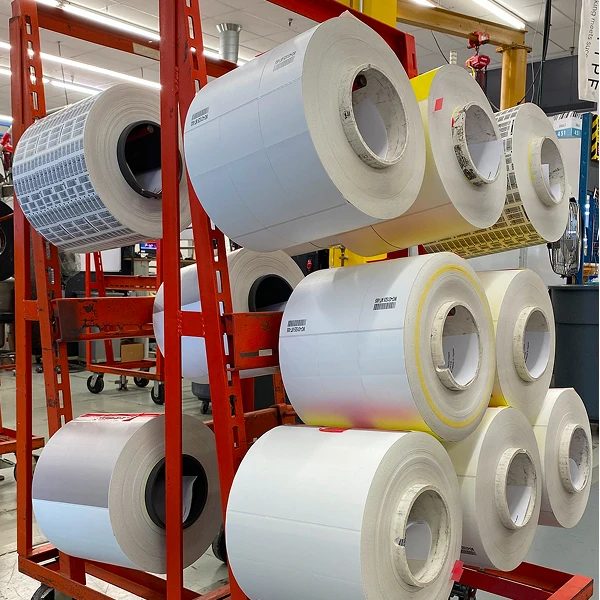
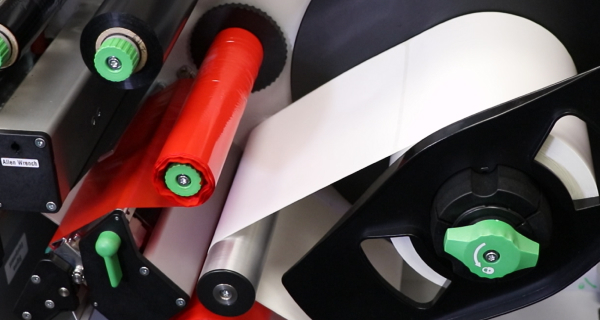
The cab XC Q printer is purpose-built for GHS compliance. With dual print heads, it applies both black and red in a single pass, making it easy to create durable, compliant hazard labels in-house. Its robust construction and high-speed output make it reliable for continuous production environments.
Prints black and red simultaneously with two ribbons
Supports durable synthetic labels suited for chemical environments
Designed for industrial reliability and large-volume label production.
Integrates easily with labeling software for seamless workflow.
Ensure your labels meet every requirement—with materials, formats, and print strategies tailored to your needs. Fill out the form and our team will help you find the most effective solution for your workflow.
GHS labels exist to make sure chemical hazards are understood instantly, no matter where a product travels or how it is handled. They combine visual symbols, standardized wording, and supplier information into one consistent format. By requiring the same structure worldwide, GHS labels reduce confusion, improve safety, and help companies stay compliant across borders.
Identify the chemical substance or mixture by name, code, or batch number. This ensures users always know exactly which product they are handling.
Use “Danger” for high-risk hazards and “Warning” for less severe ones. The signal word sets the tone for how cautious handlers need to be.
Standardized language explains the nature and degree of chemical hazards, such as causing burns, cancer, or explosions, making risks clear and consistent.
Provide specific instructions on protective equipment, storage, first aid, and disposal. These statements support users in managing the hazards safely.
Lists the name, address, and phone number of the manufacturer or distributor. This ensures accountability and offers a direct contact for more information.
Nine symbols enclosed in red diamonds quickly convey hazard type, from flammability to toxicity. They provide universal visual language for chemical safety.
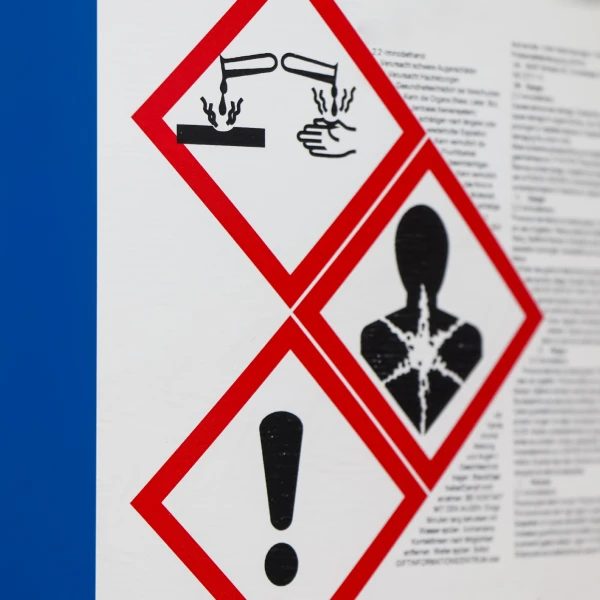
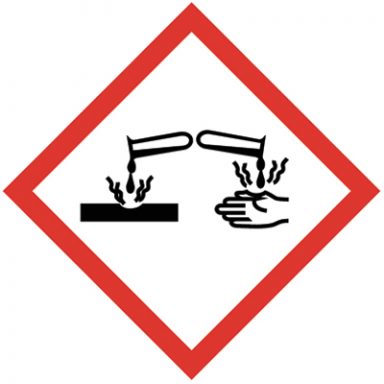
Applied to chemicals that burn skin, damage eyes, or corrode metals. Strong acids and bases often carry this pictogram to warn of severe contact hazards.
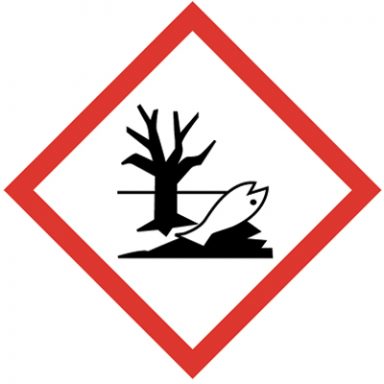
Warns of hazards to aquatic life, both immediate and long-term. Found on substances that pollute waterways or damage ecosystems, often regulated in global markets.
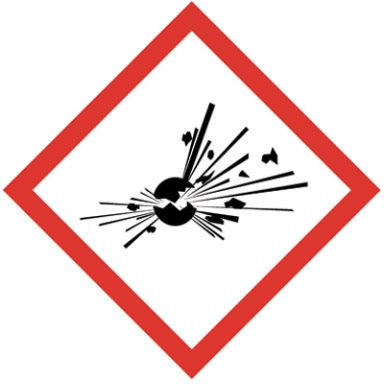
Reserved for explosives, unstable substances, or self-reactives that may detonate under heat, shock, or friction. Highlights an immediate risk of violent reaction.
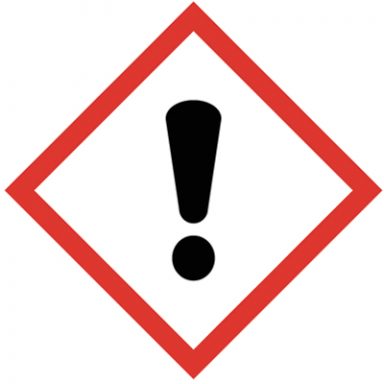
Marks substances that cause skin or eye irritation, allergic reactions, dizziness, or drowsiness. Used for lower-level acute toxicity and other moderate health hazards.
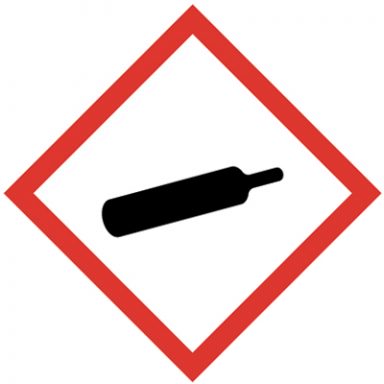
Identifies gases stored under pressure, including compressed, liquefied, or refrigerated gases. These containers can explode if heated or cause cryogenic burns on contact.
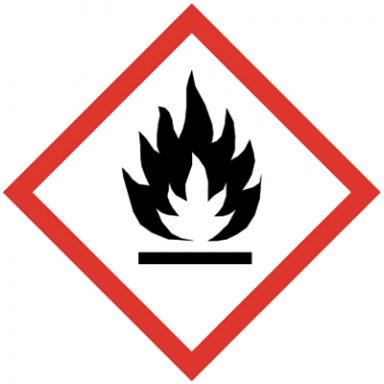
Indicates materials that catch fire easily, self-heat, release flammable gas, or react dangerously with air or water. Found on flammable liquids, solids, gases, and organic peroxides.
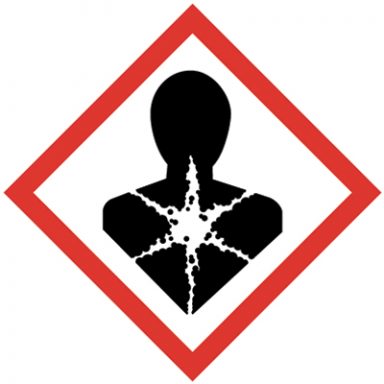
Signals long-term health effects such as cancer, genetic mutations, reproductive harm, organ damage, or respiratory sensitization. Use on chemicals that can cause serious, chronic health risks.
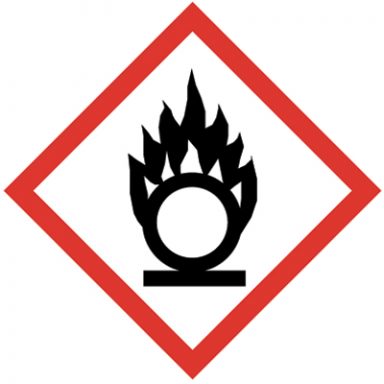
Indicates oxidizers — substances that can intensify fires or cause other materials to ignite. Common with oxidizing gases, liquids, and solids in industrial use.
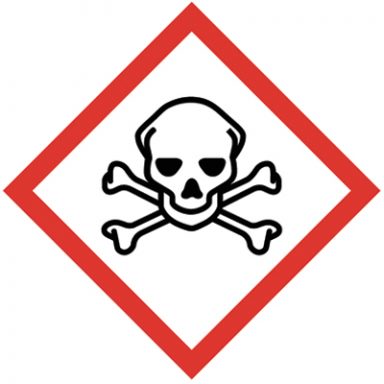
Signals acute toxicity that may be fatal or harmful in small doses, whether inhaled, swallowed, or absorbed through skin. Used for poisons and highly toxic chemicals.
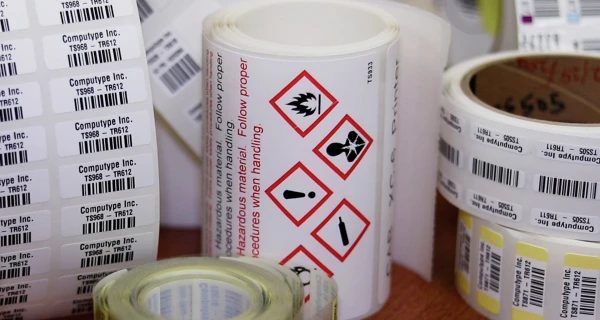
Labels must remain legible and firmly attached, resisting chemicals, moisture, and abrasion so that hazard information is never lost during handling or storage.
All containers for hazardous chemicals — from drums to vials — require labeling, unless a temporary container is used immediately by the same worker.
If new information changes a chemical’s classification, labels must be updated quickly to reflect it, ensuring accuracy and compliance across the supply chain.

Have questions? We’re here to help.
Contact us to connect with a specialist who understands your industry and can provide the right solutions for your business. Let’s start a conversation.
Pre-printed belt marking films deliver bold, consistent branding and high-resolution graphics across repeat manufacturing applications. These solutions support detailed imagery, precise color matching, and uniform visual presentation for product lines requiring fixed branding, standardized identification, and elevated product appearance.
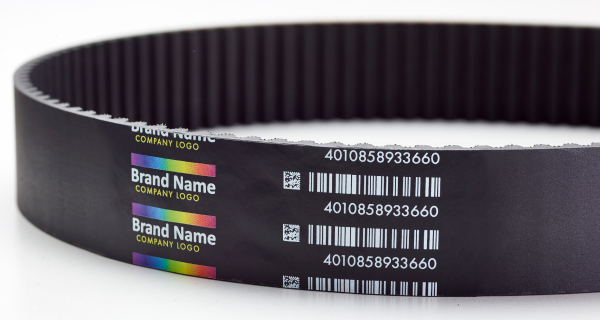
Pre-printed belt marking films support more detailed and visually controlled designs than standard ribbon-based marking systems. These solutions enable complex graphics, consistent color reproduction, and elevated product presentation across repeat manufacturing applications.
High-resolution printing supports detailed imagery, gradients, and complex visual elements beyond the capabilities of standard ribbon-based marking systems
Match specific brand colors and visual standards across belt product lines, packaging systems, and broader manufacturing identification programs
Pre-printed films maintain uniform logos, layouts, and visual presentation across large production volumes and repeat manufacturing applications
Pre-printed films are commonly used for permanent logos, product branding, belt sizes, standardized identifiers, and highly detailed visual designs. Advanced printing capabilities support precise color control, sharp graphic definition, and complex imagery that extends beyond standard ribbon-based marking.
Print-on-demand belt marking gives manufacturers the flexibility to apply critical production data directly within active manufacturing workflows. These systems support information that cannot be predefined, including slab location codes, manufacturer dates, lot information, production identifiers, and changing product data across belt runs and manufacturing environments.
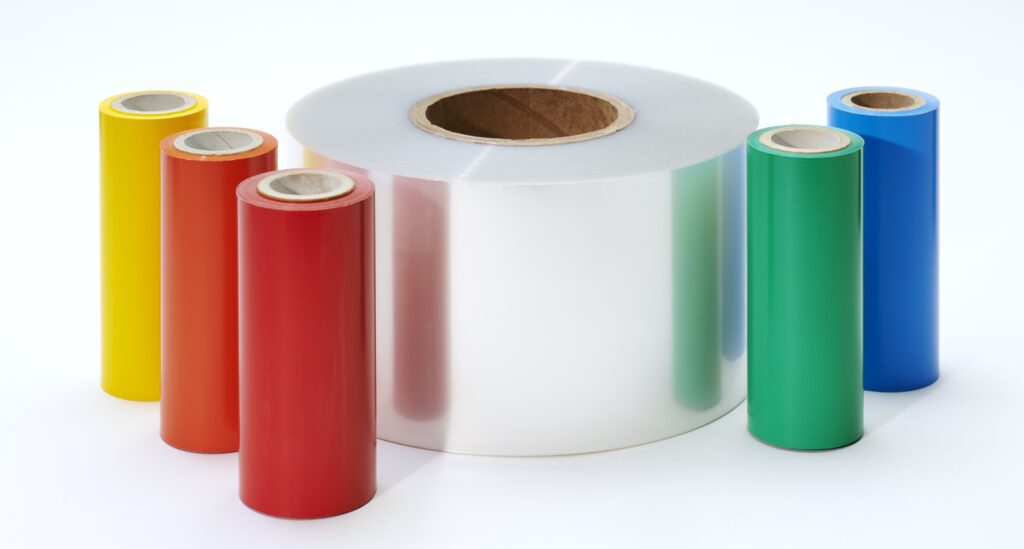
Start with blank transfer films engineered for durable rubber belt marking.
Create belt marking formats using label design and barcode software.
Use included thermal transfer ribbons to produce durable vibrant labels.
Use an industrial thermal transfer printer engineered for high duty cycles.
Print-on-demand systems are designed for manufacturing environments where belt information changes continuously throughout production. Rather than relying on fixed inventory or pre-printed stock, these systems support dynamic marking requirements tied to production scheduling, traceability, and operational control.
Use pre-printed warehouse labels to apply location IDs, pallet labels, and sequential label sets without managing printing in-house. This path works best when your data is defined and your warehouse layout follows a structured system.
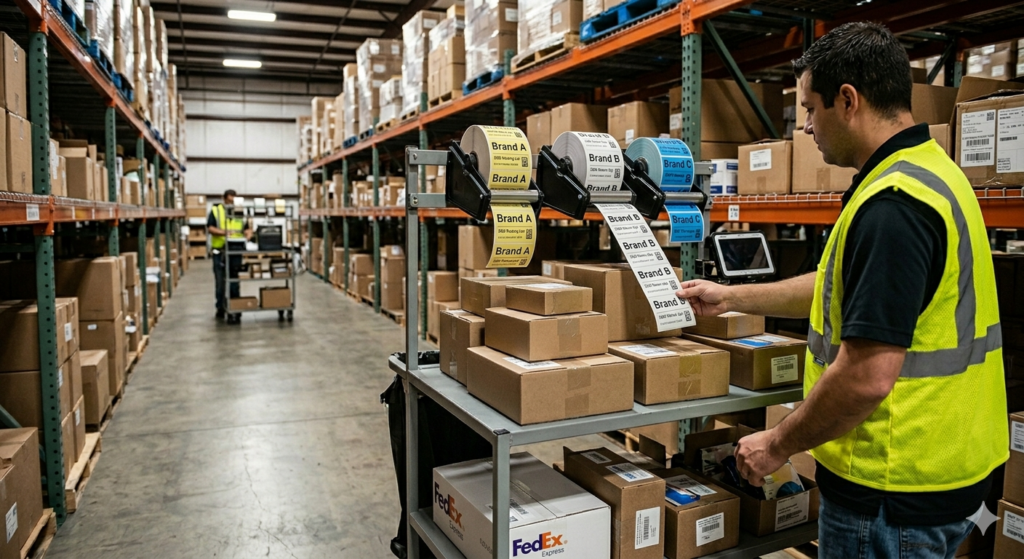
Plan your labeling system in advance, then receive labels ready to apply across your warehouse. This approach shifts the work from daily printing to upfront setup and production.
Apply the same label formats, barcodes, and ID structures across racks, pallets, and storage locations without variation.
Eliminate the need for printers, ribbons, software, and label inventory by using labels that arrive ready to apply and scan.
Use sequential beam labels and serialized label sets to maintain ordered location IDs and guarantee no duplicates.
Use pre-printed labels when your warehouse layout is defined, your location IDs are established, and you need consistent labeling across large areas or multiple facilities. This approach supports structured storage systems, standardized pallet tracking, and efficient label rollout.
Print warehouse labels in-house to create location IDs, pallet labels, and LPN labels as your warehouse changes. This path gives you direct control over how labels are created, updated, and applied across racks, bins, totes, and pallets.
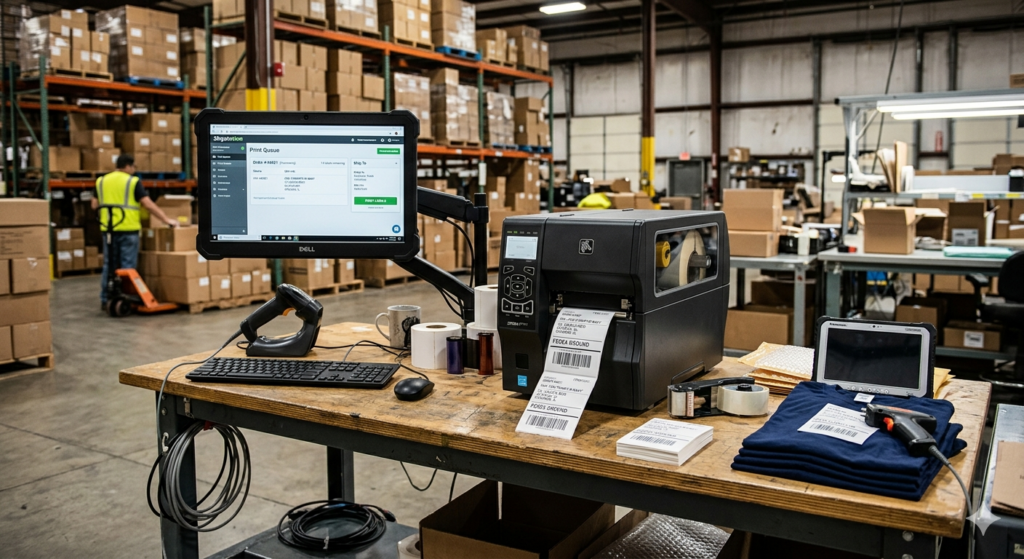
Start with blank label stock engineered for racks, bins, totes, and pallets.
Create warehouse label formats using label design and barcode software.
Use included thermal transfer ribbons to produce durable barcode labels.
Use a thermal transfer printer designed for warehouse label printing and daily use.
Use print-on-demand labels when your warehouse layout changes, your team manages location IDs internally, or you need labels immediately without waiting on production. This approach supports flexible workflows, evolving storage systems, and real-time pallet and container tracking.
Receive tubes and vials with identifiers already applied through direct marking or integrated labeling. Eliminate labeling steps entirely while ensuring durable, consistent identification across storage, handling, and laboratory workflows.
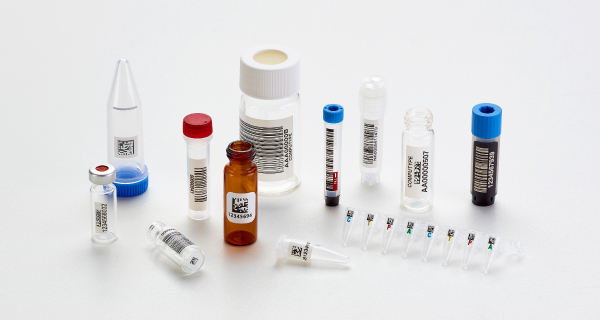
Pre-barcoded labware removes labeling from your workflow entirely. Tubes arrive ready to use with verified identifiers, supporting faster processing, reduced handling, and consistent sample identification across storage and laboratory operations.
Use pre-verified barcodes and markings to ensure consistent, accurate sample identification across all tubes and batches.
Eliminate labeling steps and reduce manual handling during sample collection, processing, and storage workflows.
Receive labware sorted, packaged, and prepared to match your workflow, including options like tare weighing and kit assembly.
Pre-barcoded labware fits high-throughput environments where labeling becomes a bottleneck or source of error. This includes biobanks managing large sample collections, clinical labs processing high volumes of patient samples, and research or CRO environments running automated or repeatable workflows where speed, consistency, and reduced handling drive efficiency and data integrity.
Get tube labels professionally printed with controlled data, advanced converting, and durable materials. Eliminate in-house printing while ensuring every label meets performance requirements for laboratory use, including chemical exposure, handling, and storage conditions.
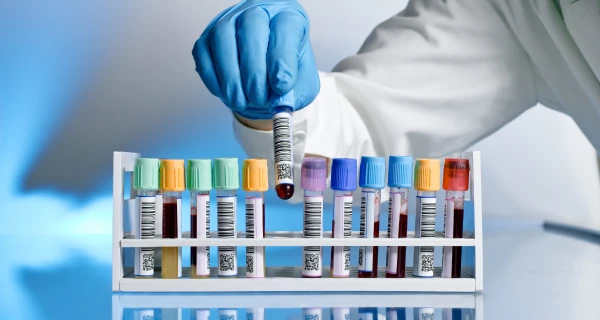
Pre-printed labeling combines controlled printing, advanced converting, and durable materials to deliver consistent, ready-to-use tube labels. This approach removes variability from in-house printing and ensures every label meets your requirements for data accuracy and performance.
Receive pre-printed labels with guaranteed unique barcode sequences, controlled serialization, and validated data across batches and production runs.
Use custom colors to organize samples, differentiate workflows, and improve visual identification across racks, boxes, and storage systems.
Use engineered label constructions with precoats and topcoats that improve resistance to chemicals, moisture, and routine laboratory handling.
Pre-printed labeling fits laboratories that manage high volumes of consistent samples and require controlled, repeatable identification. This includes clinical labs processing patient samples, diagnostic labs running standardized assays, and research labs preparing large batches of tubes for studies or long-term storage where data does not change.
Print tube labels as needed using live data from laboratory systems. Generate labels during sample collection, aliquoting, or processing, with unique identifiers, timestamps, and variable data applied at the point of use. This approach supports workflows where sample data changes frequently or requires immediate, accurate identification.
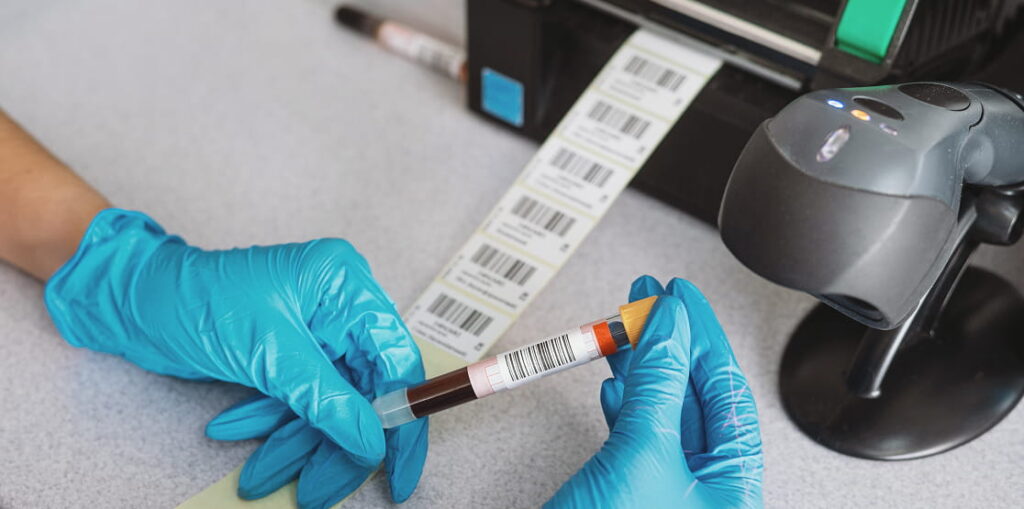
Set up a complete labeling workflow using the right materials and equipment to print and apply labels directly during laboratory processes.
Start with blank label stock engineered for small diameter tubes and vials.
Print high-resolution barcodes and text for small-format tube labels.
Use included thermal transfer ribbons to produce durable barcode labels.
Integrate tube label applicators for automated print-and-apply labeling.
Print-on-demand labeling fits laboratories that generate or modify sample data in real time. This includes research labs, clinical labs, and diagnostic environments where samples are collected, processed, and labeled on demand, and where workflows require immediate identification without waiting for pre-printed labels.
Receive microplates with identifiers already applied, eliminating labeling steps during plate setup and processing. Ensure consistent, durable identification across assays, screening, and storage while reducing manual handling and improving workflow efficiency.
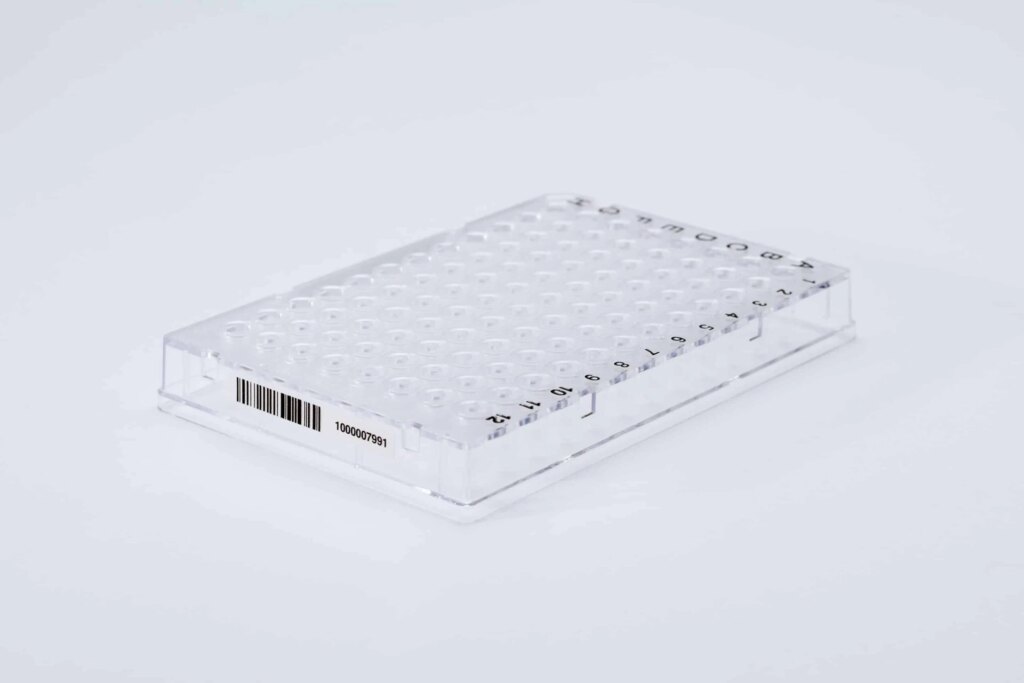
Pre-barcoded microplates arrive ready to use with verified identifiers applied before delivery. This approach removes labeling from your workflow and ensures consistent identification across plate handling, processing, and storage environments.
Eliminate labeling steps during plate setup, loading, and processing workflows.
Use pre-verified plate IDs to maintain accuracy across batches and screening runs.
Receive plates sorted, kitted, or prepared to match assay workflows and laboratory processes.
Pre-barcoded microplates fit high-throughput environments where plates move rapidly through automated workflows and labeling can create delays or variability. This includes automated screening facilities, compound and plate libraries, and CROs running large-scale studies, as well as core labs managing shared plate resources where speed, consistency, and reduced handling drive efficiency and improve data integrity.
Get microplate labels professionally printed with controlled data, advanced converting, and durable materials. Ensure consistent plate identification across batches while eliminating in-house printing and reducing variability in labeling for assays, screening, and high-throughput workflows.
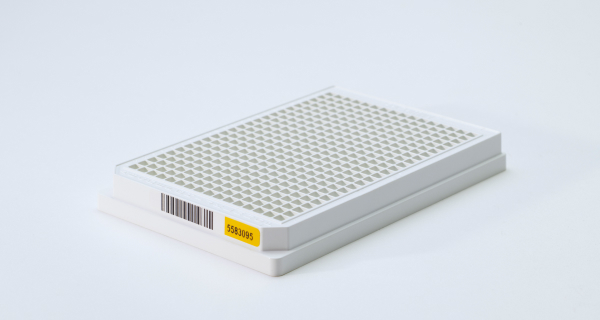
Pre-printed plate labels combine controlled printing, advanced converting, and durable materials to deliver consistent, ready-to-use identification. This approach ensures every plate label meets requirements for data accuracy, layout consistency, and performance across handling and processing.
Receive pre-printed plate labels with guaranteed unique IDs, controlled sequencing, and validated data across batches and runs.
Use color coding to differentiate assays, plate types, or workflows and improve visual organization across plate libraries.
Use engineered label constructions that resist chemicals, handling, and environmental exposure during plate processing and storage.
Pre-printed labeling fits laboratories that run standardized plate workflows with fixed data structures. This includes screening labs running standardized assays, diagnostic labs processing consistent plate formats, and research environments where plate layouts and identifiers remain consistent across runs.
Print microplate labels as needed using live data from laboratory systems. Generate labels during plate setup, sample loading, or assay preparation, with well IDs, plate IDs, and variable data applied at the point of use. This approach supports workflows where plate data changes frequently or requires immediate, accurate identification.
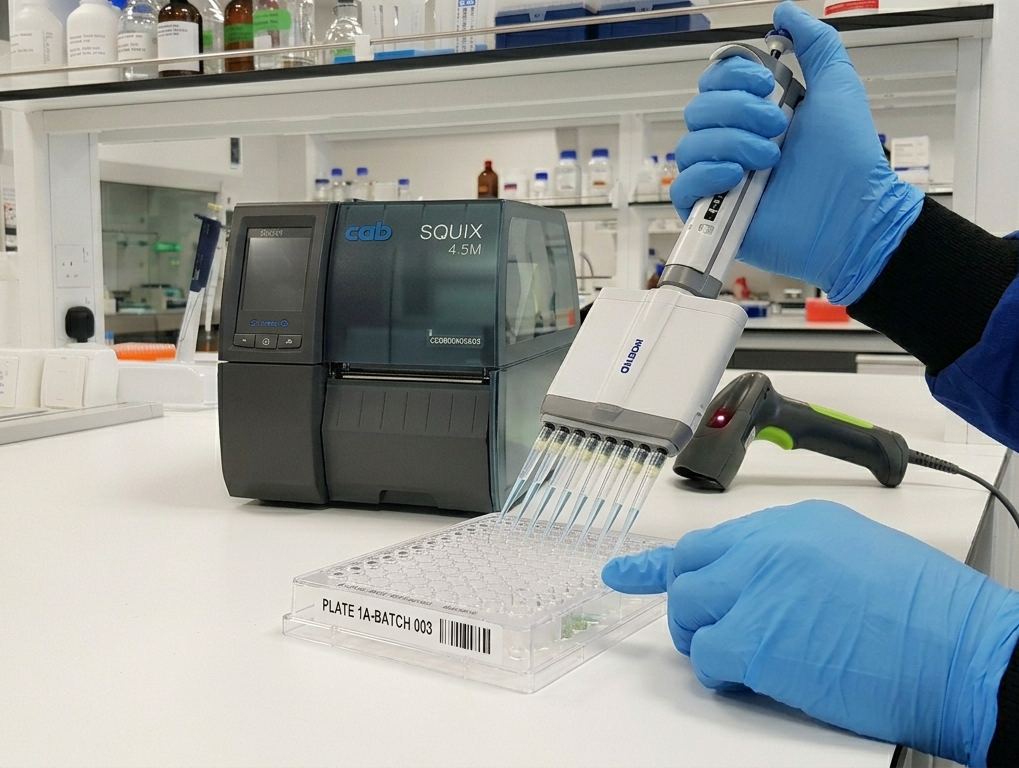
Blank plate labels designed for small formats, flat surfaces, and secure adhesion on plates.
Print high-resolution barcodes and text for plate IDs and sample tracking.
Thermal transfer ribbons produce durable images resistant to chemicals, moisture, and handling.
Apply labels consistently to plates during setup or automated workflows.
Print-on-demand labeling fits laboratories that generate or update plate data in real time. This includes screening labs, genomics workflows, and assay development environments where plates are created, modified, and labeled during processing, and where accurate, immediate identification is required.
Print blood bag labels as needed using live data from blood bank systems. Generate labels during collection, component processing, or labeling steps, with donation identification numbers, product codes, and variable data applied at the point of use. This approach supports workflows where blood data updates in real time and requires immediate, accurate identification.
Set up a complete labeling workflow using the right materials and equipment to print and apply labels directly during blood collection, component processing, and blood bank handling workflows.
Start with blank label stock engineered for flexible PVC blood bags.
Print high-resolution barcodes and text for complex blood label layouts.
Use included thermal transfer ribbons to produce durable barcode labels.
Integrate barcode software to generate ISBT 128 labels and DIN data.
Print-on-demand labeling fits blood banks and collection centers that generate or update donation data in real time. This includes blood collection sites, processing labs, and transfusion services where blood bags are labeled on demand, and workflows require immediate, accurate identification without relying on pre-printed labels.
Get blood bag labels professionally printed with controlled data, advanced converting, and durable materials. Eliminate in-house printing while ensuring every label meets performance requirements for blood bank use, including handling, cold storage, and transfusion.
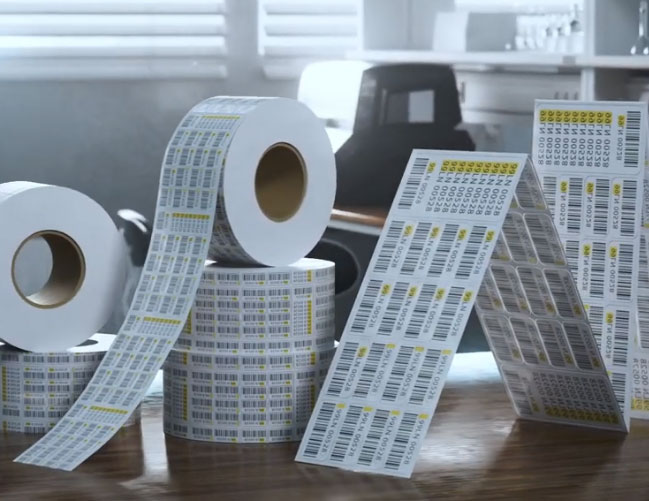
Pre-printed labeling combines controlled printing, advanced converting, and durable materials to deliver consistent, ready-to-use blood bag labels. This approach removes variability from in-house printing and ensures every label meets requirements for DIN accuracy, barcode performance, and reliable identification across blood bank workflows.
Receive pre-printed labels with guaranteed unique DIN sequences, controlled serialization, and validated data across batches and production runs.
Maintain consistent DIN formats to ensure accurate identification across blood bags, segments, and associated components.
Use engineered label constructions designed to resist edge lift, moisture, and routine handling, helping maintain adhesion and readability throughout blood collection.
Pre-printed labeling fits blood banks and collection centers that manage high volumes of donations and require controlled, repeatable identification. This includes blood collection sites, processing facilities, and transfusion services where standardized labeling, consistent DIN assignment, and stable data support efficient, validated workflows without frequent changes.
In laboratory environments, data often isn’t final until the last moment—at the bench, at the instrument, or during sample handling. Printing labels on demand helps ensure each tube or vial reflects the most accurate information, while fitting naturally into the way your work actually happens.
In laboratory environments, data often isn’t final until the last moment—at the bench, at the instrument, or during sample handling. Printing labels on demand helps ensure each tube or vial reflects the most accurate information, while fitting naturally into the way your work actually happens.
In laboratory environments, data often isn’t final until the last moment—at the bench, at the instrument, or during sample handling. Printing labels on demand helps ensure each tube or vial reflects the most accurate information, while fitting naturally into the way your work actually happens.
Compatible resin ribbons ensuring clear, durable print for barcodes and text
Compatible resin ribbons ensuring clear, durable print for barcodes and text
In laboratory environments, data often isn’t final until the last moment—at the bench, at the instrument, or during sample handling. Printing labels on demand helps ensure each tube or vial reflects the most accurate information, while fitting naturally into the way your work actually happens.
In laboratory environments, data often isn’t final until the last moment—at the bench, at the instrument, or during sample handling. Printing labels on demand helps ensure each tube or vial reflects the most accurate information, while fitting naturally into the way your work actually happens.
Compatible resin ribbons ensuring clear, durable print for barcodes and text
Compatible resin ribbons ensuring clear, durable print for barcodes and text
Compatible resin ribbons ensuring clear, durable print for barcodes and text
Compatible resin ribbons ensuring clear, durable print for barcodes and text
In laboratory environments, data often isn’t final until the last moment—at the bench, at the instrument, or during sample handling. Printing labels on demand helps ensure each tube or vial reflects the most accurate information, while fitting naturally into the way your work actually happens.
In laboratory environments, data often isn’t final until the last moment—at the bench, at the instrument, or during sample handling. Printing labels on demand helps ensure each tube or vial reflects the most accurate information, while fitting naturally into the way your work actually happens.
In laboratory environments, data often isn’t final until the last moment—at the bench, at the instrument, or during sample handling. Printing labels on demand helps ensure each tube or vial reflects the most accurate information, while fitting naturally into the way your work actually happens.
Durable labels that stay attached through handling, storage, or cryogenic conditions
Compatible resin ribbons ensuring clear, durable print for barcodes and text
Compact, consistent, durable thermal transfer printing at the point of use
Label management software to format labels and connect to sample data or LIMS
In laboratory environments, data often isn’t final until the last moment—at the bench, at the instrument, or during sample handling. Printing labels on demand helps ensure each tube or vial reflects the most accurate information, while fitting naturally into the way your work actually happens.
Take advantage of our volume discounts for bulk orders. Reach out to us for a personalized quote tailored to your needs.
"*" indicates required fields