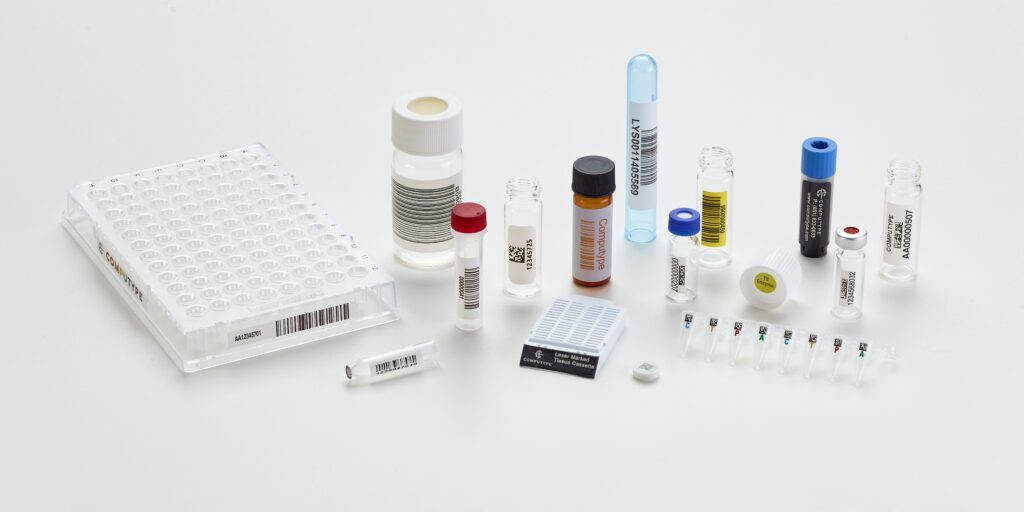
Laboratory barcodes are the foundation of modern sample identification and traceability. From research labs and biobanks to clinical diagnostics and pharmaceutical manufacturing, laboratories depend on barcode systems to accurately identify samples, reagents, labware, and equipment.
Laboratory barcode labels provide a reliable way to connect physical samples with digital records. When paired with laboratory information management systems (LIMS), barcodes allow technicians to scan samples instantly, eliminate transcription errors, and maintain complete traceability throughout testing, storage, and analysis workflows.
As laboratory operations become more automated and data-driven, barcode identification is no longer optional. Accurate barcode labeling supports regulatory compliance, protects sample integrity, and ensures that results can always be traced back to the correct source.
Why Laboratories Use Barcode Labels
Laboratories handle large volumes of samples, reagents, and labware that must be accurately identified and tracked throughout testing, storage, and analysis. Barcode labels provide a reliable way to connect physical samples with digital records, ensuring that every item can be identified quickly and consistently.
Manual labeling methods—such as handwritten notes or marker labels—can introduce errors through illegible text, transcription mistakes, or inconsistent naming. Barcode labels eliminate many of these risks by allowing technicians to scan samples and instantly retrieve the correct data from laboratory information systems or databases.
Barcode identification also supports traceability across laboratory workflows. Each scan records when a sample was created, processed, stored, or transferred, helping laboratories maintain clear documentation for quality control, audits, and regulatory compliance.
For high-throughput environments, barcode labels also improve efficiency. Scanning a sample takes seconds and allows laboratory staff to move samples through workflows with greater speed and accuracy.
Key Takeaways
A well-designed barcode system depends on several key principles:
- Unique identifiers ensure sample traceability
- Code 128 and Data Matrix dominate labs
- Barcode size and quiet zones matter
- Print durability preserves barcode readability
- Sequence control prevents duplicate identifiers
- LIMS integration supports accurate data tracking
Types of Laboratory Barcodes
Laboratories use several barcode symbologies to identify samples, labware, and laboratory assets. The appropriate barcode depends on factors such as label size, data requirements, scanning equipment, and compatibility with laboratory information systems. In practice, most laboratory barcode labels use either linear (1D) barcodes or two-dimensional (2D) barcodes.
Linear barcodes encode data in a single direction using a sequence of bars and spaces. Two-dimensional barcodes encode data in both directions, allowing significantly higher data density in a smaller area. Both formats are widely used in laboratory environments depending on the size of the label and the amount of information that must be encoded.
symbology
type
laboratory applications
key characteristics
Code 128
Linear (1D)
Sample IDs, laboratory inventory, equipment tracking
High-density linear barcode supporting full ASCII and checksum validation
Data Matrix
2D
Cryogenic vials, microcentrifuge tubes, microscope slides, microplates
Extremely compact with strong error correction and orientation-independent scanning
QR Code
2D
Linking samples to digital records, protocols, or databases
High data capacity and easily scanned by cameras and mobile devices
Code 39
Linear (1D)
Legacy laboratory systems, equipment labels, asset identification
Simple and widely supported but requires more label space
PDF417
2D (stacked linear)
Laboratory documentation, specimen transport paperwork, healthcare records
Stores large datasets; commonly used in healthcare identification systems
GS1-128
Linear (1D)
Laboratory supply chains, reagent packaging, regulated healthcare products
Code 128 with structured GS1 identifiers for traceability data
GS1 DataMatrix
2D
Healthcare specimen tracking, regulated laboratory products
Data Matrix with GS1 application identifiers for standardized data encoding
Linear Barcodes (1D)
Linear barcodes store data horizontally and are typically scanned using laser or imaging scanners. They are simple, reliable, and compatible with most barcode hardware and laboratory software systems. Linear symbologies are commonly used when labels have enough width to accommodate the barcode.
Code 128
Code 128 is a high-density linear barcode capable of encoding the full ASCII character set. It is widely used in laboratories for sample identification, asset tracking, and inventory labeling. Built-in checksum validation improves scanning reliability, and its compact design makes it more space-efficient than many older linear symbologies.
Code 39
Code 39 is an older linear barcode symbology that encodes uppercase letters, numbers, and a limited set of symbols. It is simple and widely supported by barcode scanners but requires more label space than newer formats. While still used in some laboratory systems, many labs prefer Code 128 for improved data density.
Two-Dimensional Barcodes (2D)
Two-dimensional barcodes encode data in both horizontal and vertical directions, allowing much more information to be stored in a compact area. Their high data density and error correction capabilities make them well suited for small laboratory labels and automated scanning systems.
Data Matrix
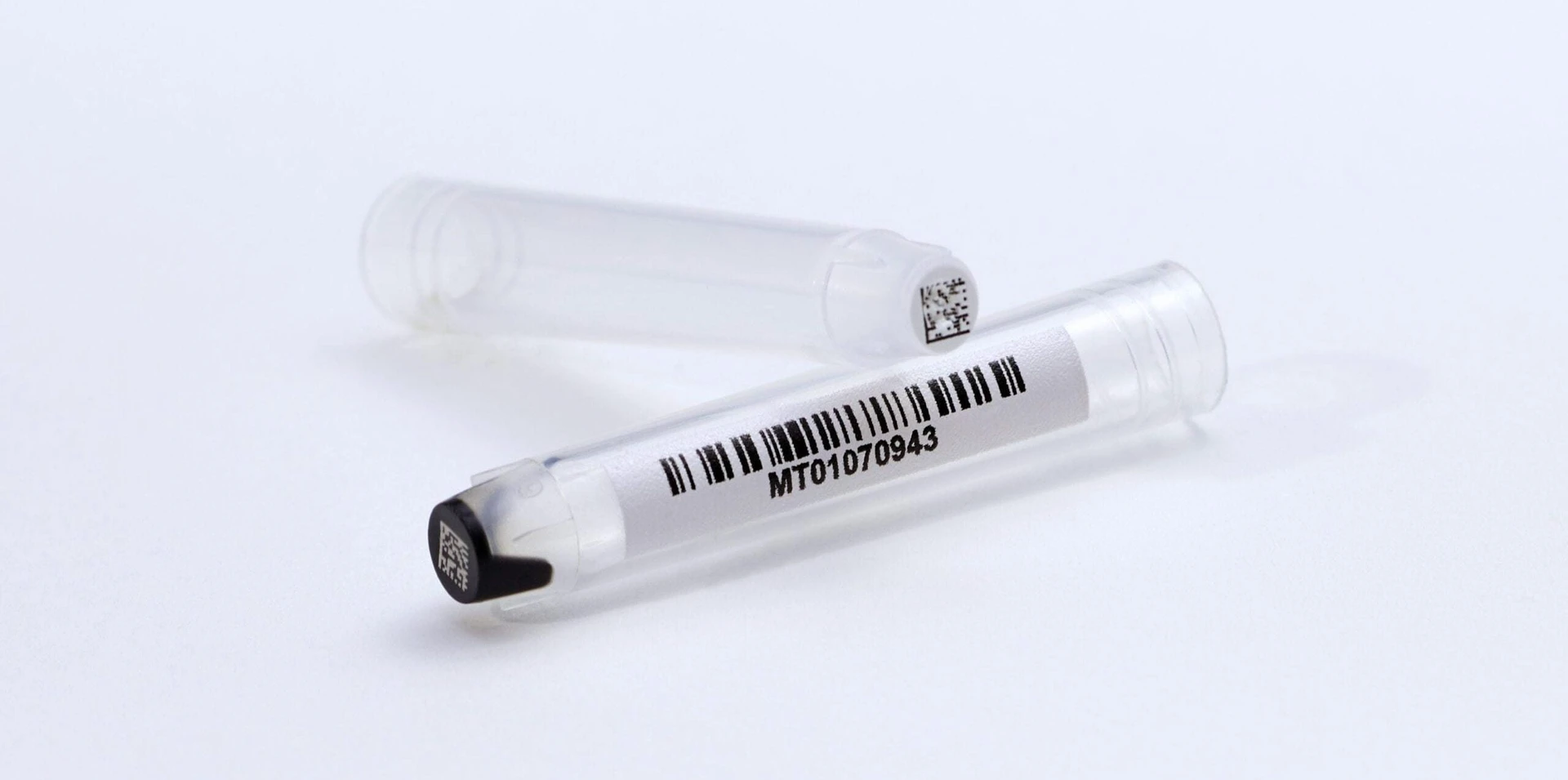
Data Matrix is one of the most widely used 2D barcodes in laboratories. Its compact grid structure allows large amounts of data to be encoded in a very small area, making it ideal for labeling tubes, vials, slides, and microplates. Built-in error correction also helps maintain readability if the symbol becomes partially damaged.
QR Codes
QR codes are two-dimensional barcodes capable of storing larger amounts of information than most linear barcodes. They are widely recognized and easily scanned by cameras and mobile devices. In laboratory environments, QR codes are sometimes used when labels must store additional data or link to external digital records.
GS1 Barcode Standards
GS1 is a global organization that defines standards for how data is structured within certain barcode formats. Rather than creating a single barcode type, GS1 specifies how identifiers such as product numbers, batch numbers, and expiration dates are encoded.
Several barcode formats support GS1 standards, including GS1-128, GS1 DataMatrix, and GS1 QR codes. These systems use structured identifiers called application identifiers (AIs) to define the meaning of each data element encoded in the barcode.
Laboratory Barcode Design
Designing effective laboratory barcode labels requires balancing barcode readability, label size constraints, and the physical conditions of laboratory environments. Labels must remain scannable throughout the life of a sample while fitting on small labware such as tubes, vials, slides, and microplates.
Barcode design decisions affect scanning reliability, workflow efficiency, and how well the label integrates with laboratory information systems. Several technical factors determine whether a barcode label will perform consistently in real laboratory conditions.
Barcode Size and Resolution
Barcode symbologies include built-in structural elements that help scanners correctly interpret encoded data.
Start and Stop Characters
Many barcode symbologies use start and stop characters to indicate where the barcode begins and ends. These markers allow the scanner to determine the correct orientation and ensure that the symbol is decoded from the proper boundaries.
Without clear start and stop patterns, scanners may fail to detect the symbol or misinterpret surrounding graphics as part of the barcode.
Check Characters
Some barcode symbologies include check characters or checksum values that help detect scanning errors. The check character is calculated mathematically from the encoded data and appended to the barcode.
When the barcode is scanned, the system recalculates the checksum to verify that the data was read correctly. If the calculated value does not match the encoded check character, the scan is rejected.
Concatenation
Concatenation allows multiple barcode symbols to be linked together to represent a longer data string. Instead of encoding all data in a single symbol, several smaller symbols are scanned sequentially and combined by the software system.
Barcode Density and Print Quality
Barcode density refers to how tightly bars or modules are packed within the symbol. Higher density allows more data to fit into a smaller space but also increases the precision required during printing and scanning.
Module Density
Module size determines the width of the smallest bar or cell in the barcode. Extremely small modules may exceed the resolution limits of the printer or scanner, reducing reliability.
Print Contrast
Barcode scanners rely on sufficient contrast between dark bars and light backgrounds. Poor contrast, faded printing, or reflective label materials can reduce readability. Proper ribbon selection, print settings, and label materials all contribute to maintaining consistent contrast.
Quiet Zones and Scan Reliability
Every barcode requires blank space on both sides known as the quiet zone. This area allows the scanner to distinguish the barcode from surrounding text or graphics.
Quiet zone requirements vary by symbology but are typically defined as a multiple of the narrowest bar or module. Maintaining adequate quiet zones is particularly important on small laboratory labels where space is limited.
Data Structure and Encoding
The information encoded within a barcode must follow a consistent structure. Laboratory barcode systems typically rely on unique identifiers linked to records in a laboratory information management system (LIMS) or database.
A well-planned data structure prevents duplicate identifiers, supports sequence management, and ensures that barcode data integrates cleanly with laboratory software systems.
Label Size and Placement
Barcode labels must fit a wide variety of labware formats, including tubes, vials, slides, and storage racks. Label size and placement affect how easily a barcode can be scanned.
Barcodes should be positioned where scanners can access them without excessive handling or rotation. Curved surfaces, tight storage racks, and automated handling systems all influence placement decisions.
Proper sizing and placement ensure that barcode labels remain readable throughout laboratory workflows.
Laboratory Barcode Regulations and Standards
Laboratories operate in regulated environments where accurate identification, traceability, and data integrity are critical. Barcode labeling systems help laboratories meet these expectations by providing consistent, machine-readable identifiers that connect physical samples to digital records. While several regulatory frameworks influence laboratory operations, the most important technical standards governing barcode quality come from the International Organization for Standardization (ISO).
ISO Barcode Quality Standards
ISO standards define how barcode symbols should be printed and evaluated to ensure they can be reliably scanned. These standards provide objective methods for grading barcode quality, helping organizations verify that printed symbols meet performance requirements before they are deployed in workflows.
Two ISO standards are particularly relevant for laboratory barcode labels.
ISO/IEC 15416: Linear Barcode Print Quality
ISO/IEC 15416 defines how the print quality of linear (1D) barcodes is measured. The standard evaluates several characteristics of a printed barcode, including symbol contrast, modulation, edge definition, and quiet zones. These factors determine whether a scanner can reliably decode the barcode under real-world conditions.
The standard uses a grading system, typically ranging from A (highest quality) to F (failure). Barcode verification equipment measures the symbol and assigns a grade based on the lowest-performing parameter. In laboratory environments where barcodes may be exposed to chemicals, condensation, or abrasion, maintaining high print quality helps ensure that sample identifiers remain readable throughout their lifecycle.
ISO/IEC 15415: 2D Barcode Print Quality
ISO/IEC 15415 defines quality grading for two-dimensional (2D) barcodes such as Data Matrix and QR codes. Instead of evaluating bar widths and spaces, this standard analyzes the quality of the cell grid that forms the 2D symbol.
Key parameters include symbol contrast, grid non-uniformity, axial distortion, and error correction performance. These measurements help determine whether scanners can accurately decode the symbol even when it is printed at very small sizes.
For laboratory applications—particularly labeling small tubes, vials, or microplates—2D barcodes are often printed at high density. Applying ISO/IEC 15415 verification helps ensure these compact symbols remain readable despite size constraints or challenging storage conditions.
ISO barcode standards have largely replaced earlier national specifications. In the United States, ANSI previously published several barcode quality standards, but these have been harmonized into the current ISO/IEC framework, which is now widely used across global supply chains and regulated industries.
Regulatory Frameworks that Require Traceability
In addition to technical barcode standards, several regulatory frameworks require laboratories to maintain accurate identification and traceability of samples, materials, and records.
Good Laboratory Practice (GLP) and Good Manufacturing Practice (GMP) establish requirements for documentation, sample tracking, and data integrity in research and production environments. Barcode labels help laboratories maintain consistent identifiers across workflows and reduce the risk of transcription errors.
In clinical settings, the Clinical Laboratory Improvement Amendments (CLIA) require laboratories to maintain reliable specimen identification and documentation procedures. Barcode systems are commonly used to support these requirements by ensuring specimens are accurately labeled and tracked throughout testing.
Electronic record systems used in regulated environments must also comply with FDA 21 CFR Part 11, which governs electronic records and electronic signatures. While the regulation does not mandate barcodes directly, barcode identification systems often play an important role in maintaining secure, traceable links between physical samples and electronic laboratory records.
Laboratory Barcode Data Integrity and Sequence Management
Accurate sample identification depends not only on barcode design but also on how barcode identifiers are generated, controlled, and managed over time. In laboratory environments, each barcode must correspond to a unique record so that samples, reagents, and laboratory assets can be traced throughout their lifecycle.
Maintaining this level of traceability requires careful management of barcode sequences and identifier history. Without proper controls, laboratories risk creating duplicate identifiers, conflicting records, or ambiguous sample references. These issues can compromise data integrity and make it difficult to reconstruct sample histories during audits or investigations.
Understanding Barcode Sequences
A barcode sequence is the structured series of identifiers used to uniquely label samples, labware, or assets within a laboratory system. Each barcode represents a specific identifier that links a physical item to a corresponding record in a laboratory information management system (LIMS) or database.
Sequences may be generated sequentially, randomly, or according to defined identifier formats that include prefixes or structured fields. Regardless of the method used, the primary requirement is that each identifier remains unique within the system. Proper sequence design helps laboratories maintain clear sample traceability while supporting scalable barcode systems as collections and workflows grow.
Unique Sample Identifiers
Most laboratory barcode systems rely on unique identifiers that act as keys linking physical samples to electronic records stored in a laboratory information management system (LIMS) or database.
Rather than encoding detailed sample information directly in the barcode, many laboratories use a short identifier that references a larger dataset within their information system. This approach keeps barcode symbols compact while allowing sample information to be updated without modifying the barcode itself.
To preserve traceability, identifiers should remain unique across the entire system. Once an identifier has been assigned to a sample, it should never be reused for a different record.
Preventing Duplicate Barcodes
Duplicate identifiers represent one of the most serious risks in laboratory barcode systems. If two samples share the same identifier, it may become impossible to determine which record corresponds to which physical sample.
Preventing duplicates requires consistent control of barcode sequences. Many laboratories implement centralized systems that generate identifiers automatically, ensuring that each new barcode is assigned a value that has not been used previously.
When identifiers are created manually or outside controlled systems, the risk of duplication increases significantly. This is particularly important when laboratories generate barcode labels across multiple locations or departments.
Print-on-Demand Labeling Considerations
Laboratories that print barcode labels on demand are responsible for managing their own identifier sequences. Label printing software or LIMS systems often generate barcode numbers automatically, but the laboratory must still ensure that identifiers remain unique across workflows and over time.
If multiple users or instruments generate barcode labels independently, additional controls may be required to prevent overlapping sequences. Laboratories may use database-driven numbering systems, prefix structures, or controlled sequence ranges to reduce the risk of duplication.
Careful configuration of label printing systems is essential to ensure that barcode identifiers remain consistent with laboratory records.
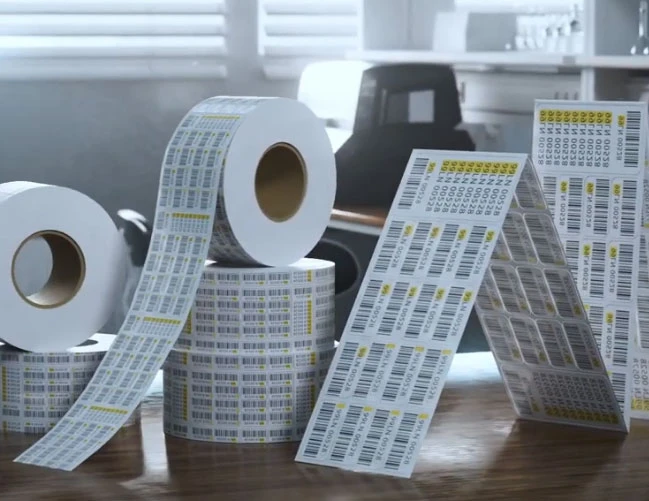
Pre-Printed Laboratory Barcode Labels
Some laboratories use pre-printed barcode labels that are manufactured with unique identifiers already encoded. In these cases, sequence management is typically handled during the label production process.
Professional label manufacturers often implement verification and inspection processes to confirm that each barcode in a sequence is printed correctly and that identifiers are not repeated within a production run. These controls help ensure that large quantities of barcode labels can be produced while maintaining both print quality and identifier uniqueness.
Because barcode labels may be reordered over time, maintaining sequence history is also important. Tracking previously issued identifier ranges helps prevent new label orders from accidentally repeating identifiers used in earlier batches.
Long-Term Identifier Management
Laboratory samples may be stored for many years, particularly in research collections and biobanks. Barcode identifiers must therefore remain stable and traceable over long time periods.
Designing identifier systems with sufficient capacity and clear sequencing rules helps ensure that barcode systems remain reliable as sample collections grow. Long-term planning also reduces the risk of sequence exhaustion or the need to redesign identification systems later.
When properly implemented, barcode sequence management provides a reliable foundation for accurate sample tracking and long-term laboratory data integrity.
Barcode Label Materials and Print Durability
The durability of a laboratory barcode label depends largely on how well the printed barcode image withstands the conditions it encounters during laboratory workflows. Samples may be exposed to chemicals, moisture, temperature changes, abrasion, and repeated handling. To maintain reliable scanning, the printed symbol must remain intact and maintain sufficient contrast throughout the life of the label.
Several factors contribute to barcode durability, including the printing method, the inks or ribbons used, and protective layers that shield the printed image from damage.
Print Methods and Image Durability
Many laboratory barcode labels are produced using thermal transfer printing, which transfers ink from a ribbon onto the label surface using heat. When properly matched with compatible label materials and coatings, thermal transfer printing produces highly durable barcode images.
Different ribbon formulations are available depending on the required level of durability. For example, resin-based ribbons are often used when labels must resist abrasion, chemicals, or extreme temperatures. Selecting the appropriate ribbon helps ensure that barcode images remain dark, well-defined, and readable throughout laboratory use.
Coatings and Print Receptivity
Label materials often include specialized surface coatings that improve how ink or ribbon material bonds to the label. These coatings enhance print receptivity and help produce sharp barcode edges with strong contrast.
In some label constructions, these coatings also chemically bond with thermal transfer ribbons during printing. This interaction helps create a more durable printed image that resists smearing, fading, or abrasion.
Maintaining high contrast between the printed bars and the background is essential for barcode scanners to reliably decode the symbol.
Protective Layers
Protective layers are often used to shield the printed barcode from environmental exposure and physical damage. These layers help maintain barcode readability in demanding laboratory environments.
For pre-printed labels, protective coatings or laminates can be applied during label production to seal the printed image beneath a durable protective layer.
For print-on-demand labeling, protection is often achieved using self-laminating labels. These labels include a clear overwrap section that is applied over the printed barcode after labeling. The transparent laminate protects the printed image while allowing laboratories to generate barcode identifiers as needed.
By combining durable printing methods, appropriate coatings, and protective layers, laboratory barcode labels can maintain reliable scanning performance throughout laboratory workflows.
Implementing Laboratory Barcodes
Once barcode standards, label design, and data structures are defined, implementing a laboratory barcode system becomes a matter of aligning hardware, software, and labeling workflows.
Most laboratory barcode systems rely on three core components: barcode printers, barcode scanners, and software systems that manage identifiers and sample records.
Thermal transfer printers are commonly used for laboratory labels because they produce durable barcode images and support a wide range of label materials. Scanners must be capable of reading the symbologies used in the laboratory environment, particularly high-density codes such as Data Matrix when working with small tubes or slides.
Barcode identifiers should be generated through controlled systems such as label software or laboratory information management systems (LIMS). These systems ensure that each barcode is unique and properly linked to a corresponding sample record.
Laboratories must also decide whether to use print-on-demand labels or pre-printed barcode labels. Print-on-demand labeling allows identifiers to be generated as needed but requires careful sequence management to prevent duplicates. Pre-printed labels provide tightly controlled sequences and consistent barcode quality, particularly when large quantities of labels are required.
Finally, barcode labels must be applied consistently within laboratory workflows. Labels should be placed where scanners can easily access them, and identification should occur at the earliest stage of sample handling to maintain traceability throughout processing and storage.
When hardware, data systems, and labeling practices are implemented together, laboratory barcodes provide a reliable framework for accurate sample tracking.
Connect with our labelling experts today
Blog article form
"*" indicates required fields