$0.00
0

Aliquot Labels: A Guide to Managing Sample Divisions

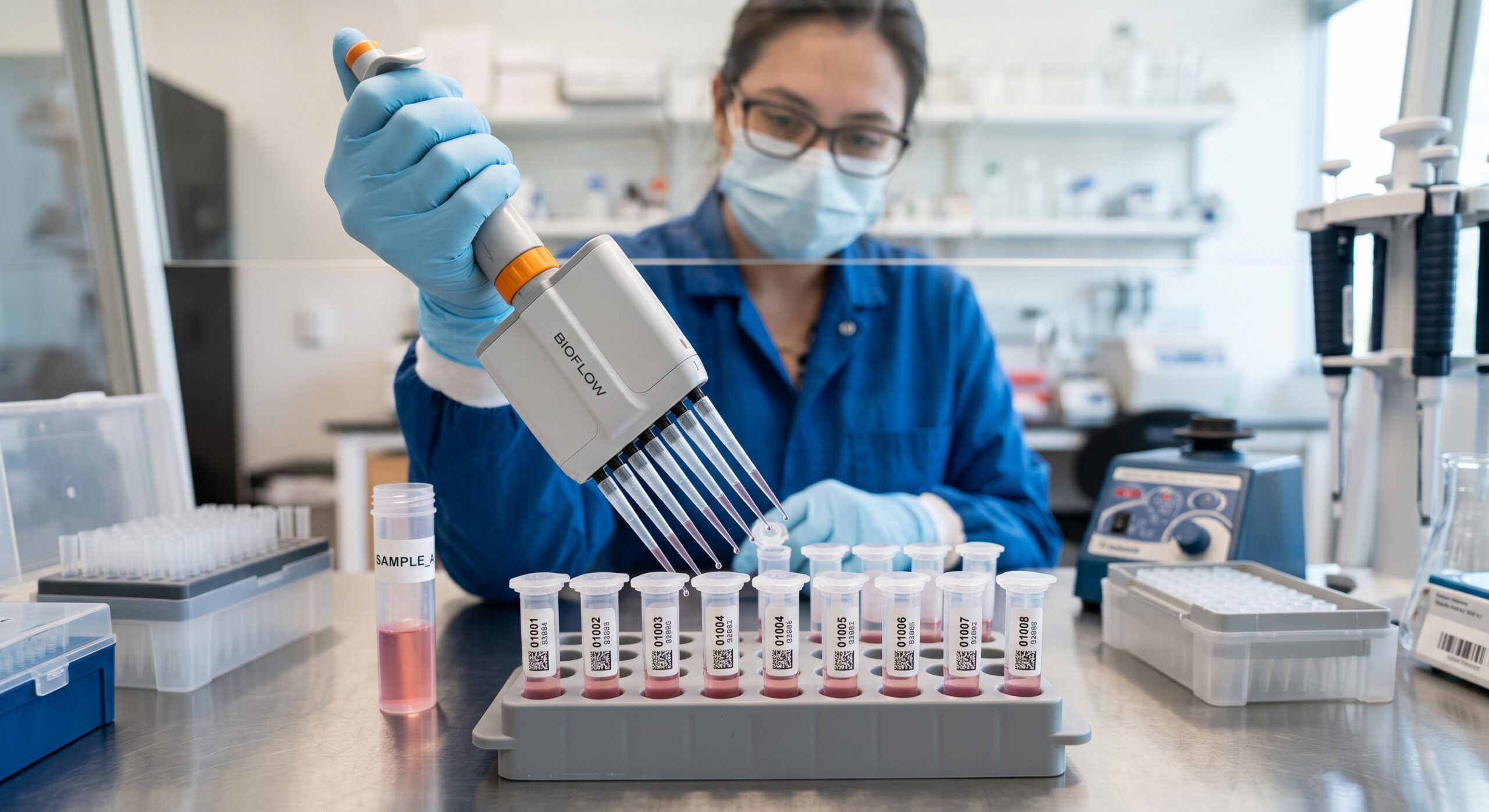
Aliquot labels give each portion of a divided sample its own physical identity while preserving its connection to the sample it came from. As one source sample becomes multiple aliquots—and those aliquots move into separate containers, storage locations, or downstream workflows—each container needs a unique identifier that distinguishes it from every related sample.

That multiplication makes aliquot identification an important part of sample tracking. Unique barcodes identify individual aliquots, while the associated data system maintains relationships between parent samples, aliquots, subaliquots, derivatives, and other records. The physical label carries that identity reliably on small tubes and through the storage conditions each aliquot encounters.

A strong aliquot labeling strategy accounts for these requirements before sample numbers begin to multiply. Barcode sequences, label construction, container size, storage conditions, sample relationships, and the decision to print laboratory labels on demand or prepare identifiers in advance all shape how a lab identifies and tracks aliquots throughout the workflow.

Aliquoting turns one sample into many identities.

Aliquoting increases the number of physical samples that researchers need to identify and track. A single source sample may become several aliquots, each stored in its own tube and handled as an individual sample from that point forward.

Every aliquot becomes a distinct physical sample

Aliquots share a common source, but each aliquot represents a separate physical object. Researchers may place them in different freezer boxes, retrieve them at different times, send them to different locations, or use them for different downstream processes. Each aliquot therefore needs an identity that distinguishes it from the other portions of the same source sample.

The numbers multiply quickly. Dividing one sample into five aliquots creates five individually identifiable containers. Dividing those aliquots again creates additional physical samples that researchers need to identify without losing their connection to the material they came from.

This distinction between shared origin and individual identity forms the basis of effective aliquot labeling. The label identifies the individual container, while the associated sample record preserves the context that connects it to related samples.

Sample multiplication creates an identification hierarchy

Aliquoting also creates relationships between the resulting samples. The source sample acts as the parent, and the aliquots created from it become related child samples. If researchers later divide an aliquot into smaller portions, those subaliquots add another generation to the sample lineage.

A simple hierarchy may look like this:

Parent sample → aliquot → subaliquot

Processing may also create derivatives rather than additional aliquots. A derivative represents material produced from another sample through a processing step, while an aliquot represents a portion of the source material. Both create related physical samples, but they represent different relationships to their source.

As these relationships branch, the identification strategy needs to accommodate both sample multiplication and sample lineage. Unique identifiers keep individual containers distinct, while the corresponding records preserve the relationships that connect each aliquot, subaliquot, or derivative to the samples that came before it.

Every aliquot needs a unique identifier.

Each aliquot needs a unique identifier that represents that individual physical sample. When researchers divide one source sample among several tubes, the source identifier alone no longer distinguishes which aliquot they store, retrieve, transfer, or process.

Barcode labels turn those unique identifiers into machine-readable identities that researchers can scan throughout the aliquot workflow. As sample numbers multiply, the barcode sequence needs to maintain the same uniqueness as the samples it represents.

Unique barcode sequences distinguish individual aliquots

Serialized barcode sequences assign a different identifier to every aliquot. Instead of repeating the parent sample ID across several containers, researchers assign each aliquot a unique value that follows that physical sample through storage and downstream use.

Sequence management becomes increasingly important as aliquot counts grow. Duplicate identifiers create ambiguity because two physical samples point to the same identity. A controlled barcode sequence prevents duplicate assignments and preserves a one-to-one relationship between each unique identifier and the aliquot it represents.

Labs can generate these sequences through their own data and label-printing systems or work with professionally preprinted aliquot labels that arrive with controlled unique sequences. The appropriate approach depends on how the lab creates, assigns, and manages identifiers within its existing workflow.

Unique identifiers do not need to describe the sample

A unique identifier does not need to encode every attribute associated with an aliquot. Participant information, specimen type, collection details, storage location, and parent-sample relationships can remain in the associated data system rather than becoming part of the identifier itself.

This separation keeps the identifier focused on one function: uniquely identifying the aliquot. It also preserves the aliquot’s identity when contextual information changes. Moving a tube to another freezer position, for example, changes its location but not its unique identifier.

Barcodes connect aliquot labels to digital records

The barcode encodes the unique identifier in a machine-readable format. Linear barcode symbologies can support aliquot identification when sufficient label space exists, while compact 2D symbols such as Data Matrix encode identifiers within the smaller areas available on many aliquot tubes.

Barcode design also has to preserve readability. Symbol dimensions, print resolution, contrast, placement, and print quality all influence whether scanners reliably decode an identifier, particularly as barcode size decreases.

Scanning the aliquot label retrieves the unique identity that connects the physical container to its corresponding digital record. That record maintains the richer sample information and relationships behind the identifier, while the barcode provides a consistent machine-readable key between the physical aliquot and its data.

Track parent-child relationships between aliquots.

Unique identifiers distinguish individual aliquots, but they also need to support the relationships that connect those aliquots to their source material. When researchers divide a sample, they create multiple independently identifiable containers without eliminating the shared origin between them.

Connect each aliquot to its parent sample

A parent-child relationship connects each aliquot to the sample from which researchers created it. The parent sample retains its own identifier, while each resulting aliquot receives a separate identifier that represents the new physical container.

For example, one parent sample might produce six aliquots with six unique barcode IDs. The six barcodes identify six different physical samples, while the associated records connect all six aliquots to the same parent.

This structure separates two important pieces of information: which aliquot is this, and where did it come from? The unique barcode answers the first question. The parent-child relationship recorded in the sample management system answers the second.

Maintain sample lineage through subaliquots

Sample relationships can extend beyond a single division. Researchers may later divide an aliquot again, creating subaliquots that require their own unique identifiers and a connection to the aliquot that served as their immediate source.

The resulting lineage may follow a structure such as:

Parent sample → aliquot → subaliquot

Each division adds physical samples and unique identifiers without replacing the relationships established earlier in the workflow. Maintaining those connections allows researchers to trace a subaliquot through its immediate parent and back to the original source sample.

Distinguish aliquots from derived samples

Not every child sample represents an aliquot. Aliquoting divides source material into portions, while processing can produce a derivative with properties that differ from its source. Both operations create new physical samples that require identification, but they establish different relationships within the sample lineage.

Unique barcode IDs identify each physical object regardless of relationship type. The associated records define whether that object represents an aliquot, subaliquot, derivative, or another related sample.

Keep sample relationships in the data record

Aliquot labels do not need to display or encode the entire sample lineage. As parent-child relationships extend across multiple generations, fitting that structure into a barcode or human-readable identifier quickly becomes impractical.

Instead, the aliquot label carries the unique identifier that connects the physical sample to its record. The data system maintains the parent-child relationships behind that ID, allowing one compact barcode to provide access to a much larger sample history without requiring the label itself to describe that history.
What goes on an aliquot label?

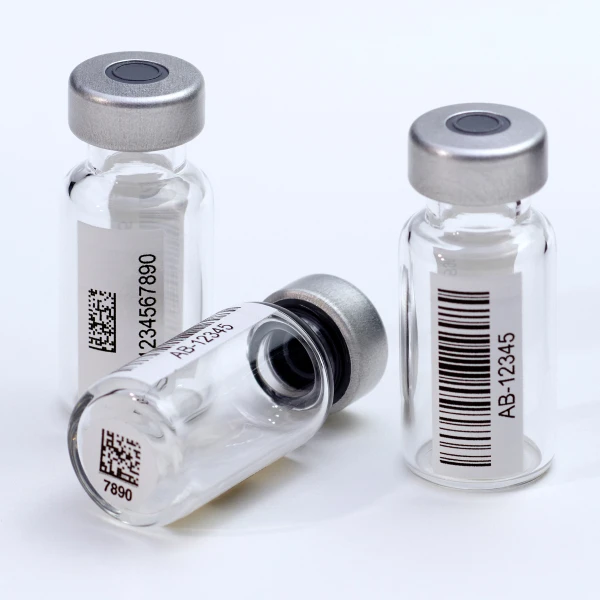
Aliquot labels need to identify individual samples within the space available on each container. A unique barcode typically serves as the primary machine-readable identifier, while human-readable information gives researchers a way to recognize or verify the aliquot without relying exclusively on a scanner.

The exact label content depends on the workflow, container size, data system, and information researchers need at the point of use.

Unique machine-readable barcode

The barcode represents the aliquot’s unique identifier in a form that scanners can capture quickly and consistently. Each barcode needs to correspond to one individual aliquot, maintaining the one-to-one relationship between the physical container and its unique ID.

Barcode format depends partly on available space and existing systems. Linear symbologies such as Code 128 require more horizontal space, while 2D symbologies such as Data Matrix encode identifiers within a compact area. That smaller footprint makes Data Matrix particularly relevant to aliquot labels for small tubes and vials.

The barcode should contain the data the system needs to identify the aliquot. Encoding additional information simply because the barcode has capacity adds complexity without necessarily adding value.

Human-readable identification

Human-readable text complements the barcode by giving researchers visible information they can use without scanning the aliquot. At minimum, this may include a human-readable representation of the unique ID so someone can compare the printed identifier with the barcode record when necessary.

Additional text depends on the workflow. A lab may include study-specific information, sample type, dates, or other identifiers that researchers need during handling. Available label space often forces prioritization, especially on small aliquot tubes.

Workflow-specific visual information

Aliquot labels can also incorporate visual elements that support established laboratory workflows. Color coding, for example, can differentiate predefined sample groups, studies, batches, or other categories when the lab already uses color as part of its identification strategy.

Visual cues supplement unique identification rather than replace it. Two aliquots within the same color-coded group still require separate unique identifiers and barcodes.

Keep detailed sample relationships in the data system

An aliquot label does not need to reproduce the complete history behind the sample. Parent IDs, previous generations, processing history, storage records, and other contextual data can quickly exceed the physical space available on a tube.

The unique barcode provides the connection between the aliquot and that information. Keeping the physical label focused on identification allows a compact aliquot label to represent a much richer digital record without overcrowding the container or barcode.

Aliquot labels need to match the physical workflow.

Aliquot labels have to maintain reliable identification on the specific containers researchers use and through the conditions those containers encounter. Tube dimensions, available labeling area, storage temperature, and the point at which researchers apply the label all shape the physical label requirements.

Small aliquot tubes limit labeling space

Aliquoting often moves samples into small tubes and vials with limited surface area for identification. Container diameter and curvature restrict label dimensions, while the unique barcode and essential human-readable information still need enough space to remain usable.

The label construction also needs to conform to the container without interfering with normal handling, closure, racks, or storage. Designing the aliquot label around the actual labware provides a more reliable starting point than reducing the dimensions of a label designed for a larger container.

Compact barcodes support small aliquot labels

Two-dimensional symbologies such as Data Matrix encode unique identifiers within a compact footprint, making them well suited to many small aliquot labels. Small symbols place greater demands on barcode resolution, module size, contrast, and print quality because scanners still need to resolve each element of the code accurately.

The smallest barcode that physically fits does not necessarily provide the best solution. Barcode dimensions need to support reliable decoding with the scanners and handling processes used in the workflow.

Aliquot label construction follows the storage environment

Aliquots from the same parent sample may move to different storage locations or downstream workflows. Each aliquot label needs a face stock, adhesive, and printed image that remain intact and readable through the conditions that individual container encounters.

Refrigerated, frozen, −80°C, and cryogenic storage environments place different demands on label construction. Long-term identification also requires the printed barcode and human-readable information to remain readable alongside the physical bond between the label and container.

Label timing changes the adhesive requirements

Researchers who identify aliquot tubes before freezing can select labels for the intended storage environment and apply them under the construction’s specified application conditions. Labeling or relabeling aliquots that have already reached frozen storage creates a different adhesive requirement because the label must establish its initial bond at that colder application temperature.

Planning when researchers will identify the aliquot therefore matters alongside where they will store it. The container, barcode, label construction, and application point need to work together as one physical identification system.
Plan aliquot identification before samples are divided.

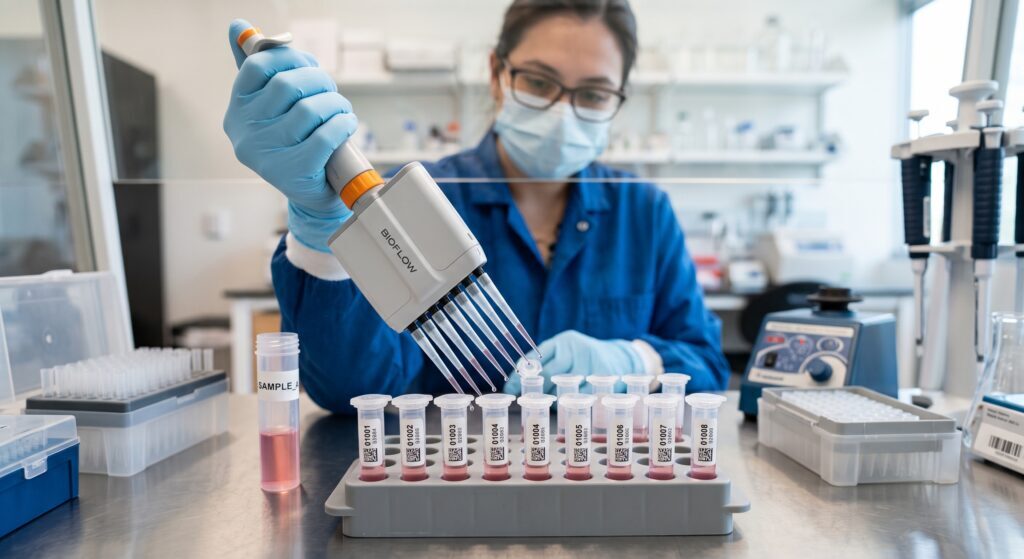
Aliquot identification does not have to begin after researchers divide a sample. When a workflow follows a predictable aliquoting structure, labs can prepare unique identifiers, barcode labels, or pre-barcoded receiving tubes before the source sample reaches the aliquoting step.

Planning identification in advance moves barcode preparation out of the active workflow and establishes how researchers will identify the resulting aliquots before sample numbers multiply.

Prepare serialized aliquot labels in advance

Preprinted aliquot labels provide a controlled sequence of unique barcode identifiers for researchers to apply as they create new samples. Professional printing also moves barcode generation and print production outside the lab, reducing the number of identification tasks researchers need to complete during aliquoting.

Sequence management remains critical. Each printed barcode needs a unique value, and the complete sequence needs to avoid duplicate identifiers. Labs can also specify human-readable IDs and other fixed or variable information when the workflow requires more than a machine-readable barcode.

Start with pre-barcoded aliquot tubes

Pre-barcoded tubes move identification one step earlier by giving each receiving container a unique identity before researchers transfer any sample into it. Instead of creating an aliquot and then producing an identifier for the new container, researchers divide the parent sample directly into tubes that already carry unique barcodes.

This approach removes label printing and application from the aliquoting step. It also allows the barcode construction, placement, print quality, and sequence to undergo preparation before the tubes enter the lab workflow.

Pre-barcoded labware makes the most sense when labs know the tube format and identification requirements in advance. Workflows that require researchers to determine identifiers dynamically during processing may need more flexible on-demand printing.

Plan identifiers alongside sample relationships

Predictable aliquoting also creates an opportunity to plan how unique identifiers will correspond to the samples researchers expect to create. A parent sample that routinely produces a defined set of aliquots creates a different identification structure from a workflow where the number of resulting samples changes from one parent to another.

The barcode sequence does not need to encode those relationships. Instead, labs can establish unique identities for the expected containers while their data system maintains the connections between each aliquot and its parent. Planning both pieces together gives the physical identifiers and sample relationships a defined structure before aliquoting begins.

Aliquot labels preserve identity as samples multiply.

Aliquoting multiplies physical samples without eliminating the relationships between them. Each aliquot needs its own identity, while the identification system needs to preserve its connection to the parent sample and any additional relationships researchers create through further division or processing.

Aliquot labels provide the physical link between those individual containers and their digital records. Unique barcode sequences identify each aliquot, while the data system maintains the sample relationships and information behind those identifiers. The label construction keeps that identity readable through the handling and storage conditions each aliquot encounters.

The right labeling approach depends partly on how the workflow creates aliquots. Labs that create variable aliquots in smaller quantities may prioritize the flexibility of on-demand barcode printing. More predictable or higher-volume workflows may shift identification upstream with preprinted serialized labels or pre-barcoded aliquot tubes. Every approach still requires unique identifiers, controlled barcode sequences, and labels designed for the containers and conditions involved.

Planning those requirements before samples multiply creates a stronger foundation for aliquot tracking. Start with the number and types of aliquots the workflow creates, the relationships researchers need to maintain, the labware and storage conditions involved, and when each container receives its identity.

Planning an aliquoting workflow or looking for a more reliable way to identify and track aliquots? Fill out our discovery form to start building the right labeling approach.

0
    0
    Your Cart
    Your cart is emptyReturn to Shop

    High-impact belt branding with pre-printed films.

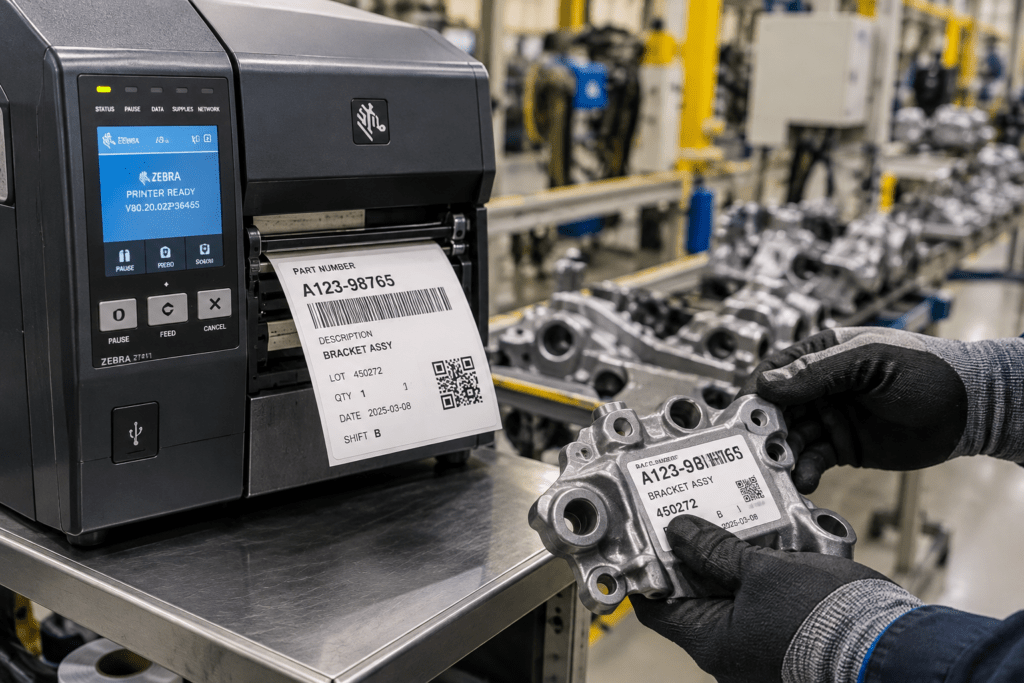
    Pre-printed belt marking films deliver bold, consistent branding and high-resolution graphics across repeat manufacturing applications. These solutions support detailed imagery, precise color matching, and uniform visual presentation for product lines requiring fixed branding, standardized identification, and elevated product appearance.

    Professionally printed high-resolution rubber belt branding films.

    Pre-printed belt marking films support more detailed and visually controlled designs than standard ribbon-based marking systems. These solutions enable complex graphics, consistent color reproduction, and elevated product presentation across repeat manufacturing applications.

    photorealistic graphics

    High-resolution printing supports detailed imagery, gradients, and complex visual elements beyond the capabilities of standard ribbon-based marking systems

    custom color matching

    Match specific brand colors and visual standards across belt product lines, packaging systems, and broader manufacturing identification programs

    consistent production

    Pre-printed films maintain uniform logos, layouts, and visual presentation across large production volumes and repeat manufacturing applications

    Pre-printed films are commonly used for permanent logos, product branding, belt sizes, standardized identifiers, and highly detailed visual designs. Advanced printing capabilities support precise color control, sharp graphic definition, and complex imagery that extends beyond standard ribbon-based marking.

    Print belt marking films with critical production data.

    Print-on-demand belt marking gives manufacturers the flexibility to apply critical production data directly within active manufacturing workflows. These systems support information that cannot be predefined, including slab location codes, manufacturer dates, lot information, production identifiers, and changing product data across belt runs and manufacturing environments.

    A simple setup can integrate real-time labeling directly into your workflow.

    durable films

    Start with blank transfer films engineered for durable rubber belt marking.

    label software

    Create belt marking formats using label design and barcode software.

    compatible ribbons

    Use included thermal transfer ribbons to produce durable vibrant labels.

    industrial printers

    Use an industrial thermal transfer printer engineered for high duty cycles.

    Print-on-demand systems are designed for manufacturing environments where belt information changes continuously throughout production. Rather than relying on fixed inventory or pre-printed stock, these systems support dynamic marking requirements tied to production scheduling, traceability, and operational control.

    Reduce operational complexity with pre-printed labels.

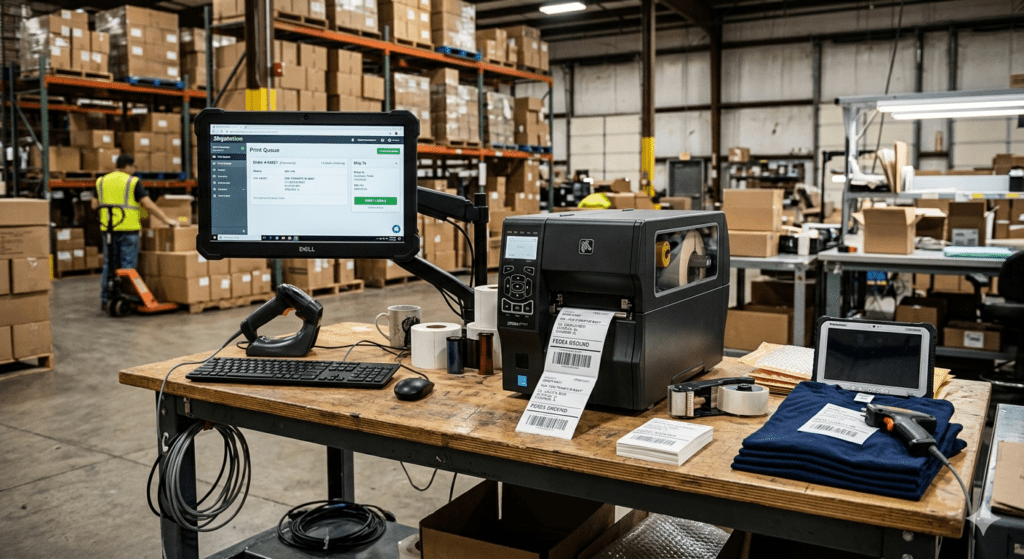
    Use pre-printed warehouse labels to apply location IDs, pallet labels, and sequential label sets without managing printing in-house. This path works best when your data is defined and your warehouse layout follows a structured system.

    A simple setup can integrate real-time labeling directly into your workflow.

    Plan your labeling system in advance, then receive labels ready to apply across your warehouse. This approach shifts the work from daily printing to upfront setup and production.

    consistency at scale

    Apply the same label formats, barcodes, and ID structures across racks, pallets, and storage locations without variation.

    efficient operations

    Eliminate the need for printers, ribbons, software, and label inventory by using labels that arrive ready to apply and scan.

    sequence management

    Use sequential beam labels and serialized label sets to maintain ordered location IDs and guarantee no duplicates.

    Use pre-printed labels when your warehouse layout is defined, your location IDs are established, and you need consistent labeling across large areas or multiple facilities. This approach supports structured storage systems, standardized pallet tracking, and efficient label rollout.

    Print labels when inventory data changes in real time.

    Print warehouse labels in-house to create location IDs, pallet labels, and LPN labels as your warehouse changes. This path gives you direct control over how labels are created, updated, and applied across racks, bins, totes, and pallets.

    A simple setup can integrate real-time labeling directly into your workflow.

    durable labels

    Start with blank label stock engineered for racks, bins, totes, and pallets.

    label software

    Create warehouse label formats using label design and barcode software.

    compatible ribbons

    Use included thermal transfer ribbons to produce durable barcode labels.

    label printers

    Use a thermal transfer printer designed for warehouse label printing and daily use.

    Use print-on-demand labels when your warehouse layout changes, your team manages location IDs internally, or you need labels immediately without waiting on production. This approach supports flexible workflows, evolving storage systems, and real-time pallet and container tracking.

    Receive pre-barcoded tubes immediately ready-to-use.

    Receive tubes and vials with identifiers already applied through direct marking or integrated labeling. Eliminate labeling steps entirely while ensuring durable, consistent identification across storage, handling, and laboratory workflows.

    Pre-barcoded tubes for extreme durability and precision placement.

    Pre-barcoded labware removes labeling from your workflow entirely. Tubes arrive ready to use with verified identifiers, supporting faster processing, reduced handling, and consistent sample identification across storage and laboratory operations.

    consistency at scale

    Use pre-verified barcodes and markings to ensure consistent, accurate sample identification across all tubes and batches.

    efficient lab management

    Eliminate labeling steps and reduce manual handling during sample collection, processing, and storage workflows.

    labware prepâ„¢ services

    Receive labware sorted, packaged, and prepared to match your workflow, including options like tare weighing and kit assembly.

    Pre-barcoded labware fits high-throughput environments where labeling becomes a bottleneck or source of error. This includes biobanks managing large sample collections, clinical labs processing high volumes of patient samples, and research or CRO environments running automated or repeatable workflows where speed, consistency, and reduced handling drive efficiency and data integrity.

    Order pre-printed tube labels for guaranteed accuracy.

    Get tube labels professionally printed with controlled data, advanced converting, and durable materials. Eliminate in-house printing while ensuring every label meets performance requirements for laboratory use, including chemical exposure, handling, and storage conditions.

    Professionally printed laboratory tube labels for custom, sequential labels.

    Pre-printed labeling combines controlled printing, advanced converting, and durable materials to deliver consistent, ready-to-use tube labels. This approach removes variability from in-house printing and ensures every label meets your requirements for data accuracy and performance.

    unique ids

    Receive pre-printed labels with guaranteed unique barcode sequences, controlled serialization, and validated data across batches and production runs.

    custom design

    Use custom colors to organize samples, differentiate workflows, and improve visual identification across racks, boxes, and storage systems.

    durable finishing

    Use engineered label constructions with precoats and topcoats that improve resistance to chemicals, moisture, and routine laboratory handling.

    Pre-printed labeling fits laboratories that manage high volumes of consistent samples and require controlled, repeatable identification. This includes clinical labs processing patient samples, diagnostic labs running standardized assays, and research labs preparing large batches of tubes for studies or long-term storage where data does not change.

    Print tube labels on demand with real-time data.

    Print tube labels as needed using live data from laboratory systems. Generate labels during sample collection, aliquoting, or processing, with unique identifiers, timestamps, and variable data applied at the point of use. This approach supports workflows where sample data changes frequently or requires immediate, accurate identification.

    A simple setup can integrate real-time labeling directly into your workflow.

    Set up a complete labeling workflow using the right materials and equipment to print and apply labels directly during laboratory processes.

    durable labels

    Start with blank label stock engineered for small diameter tubes and vials.

    label printers

    Print high-resolution barcodes and text for small-format tube labels.

    compatible ribbons

    Use included thermal transfer ribbons to produce durable barcode labels.

    tube labelers

    Integrate tube label applicators for automated print-and-apply labeling.

    Print-on-demand labeling fits laboratories that generate or modify sample data in real time. This includes research labs, clinical labs, and diagnostic environments where samples are collected, processed, and labeled on demand, and where workflows require immediate identification without waiting for pre-printed labels.

    Use pre-barcoded microplates for ready-to-use identification.

    Receive microplates with identifiers already applied, eliminating labeling steps during plate setup and processing. Ensure consistent, durable identification across assays, screening, and storage while reducing manual handling and improving workflow efficiency.

    Pre-barcoded microplates for ultimate laboratory efficiency.

    Pre-barcoded microplates arrive ready to use with verified identifiers applied before delivery. This approach removes labeling from your workflow and ensures consistent identification across plate handling, processing, and storage environments.

    laboratory efficiency

    Eliminate labeling steps during plate setup, loading, and processing workflows.

    consistent identification

    Use pre-verified plate IDs to maintain accuracy across batches and screening runs.

    integrated services

    Receive plates sorted, kitted, or prepared to match assay workflows and laboratory processes.

    Pre-barcoded microplates fit high-throughput environments where plates move rapidly through automated workflows and labeling can create delays or variability. This includes automated screening facilities, compound and plate libraries, and CROs running large-scale studies, as well as core labs managing shared plate resources where speed, consistency, and reduced handling drive efficiency and improve data integrity.

    Order pre-printed microplate labels with consistent accuracy.

    Get microplate labels professionally printed with controlled data, advanced converting, and durable materials. Ensure consistent plate identification across batches while eliminating in-house printing and reducing variability in labeling for assays, screening, and high-throughput workflows.

    Professionally printed custom microplate labels.

    Pre-printed plate labels combine controlled printing, advanced converting, and durable materials to deliver consistent, ready-to-use identification. This approach ensures every plate label meets requirements for data accuracy, layout consistency, and performance across handling and processing.

    unique ids

    Receive pre-printed plate labels with guaranteed unique IDs, controlled sequencing, and validated data across batches and runs.

    custom design

    Use color coding to differentiate assays, plate types, or workflows and improve visual organization across plate libraries.

    durable finishing

    Use engineered label constructions that resist chemicals, handling, and environmental exposure during plate processing and storage.

    Pre-printed labeling fits laboratories that run standardized plate workflows with fixed data structures. This includes screening labs running standardized assays, diagnostic labs processing consistent plate formats, and research environments where plate layouts and identifiers remain consistent across runs.

    Print microplate labels on demand with real-time data.

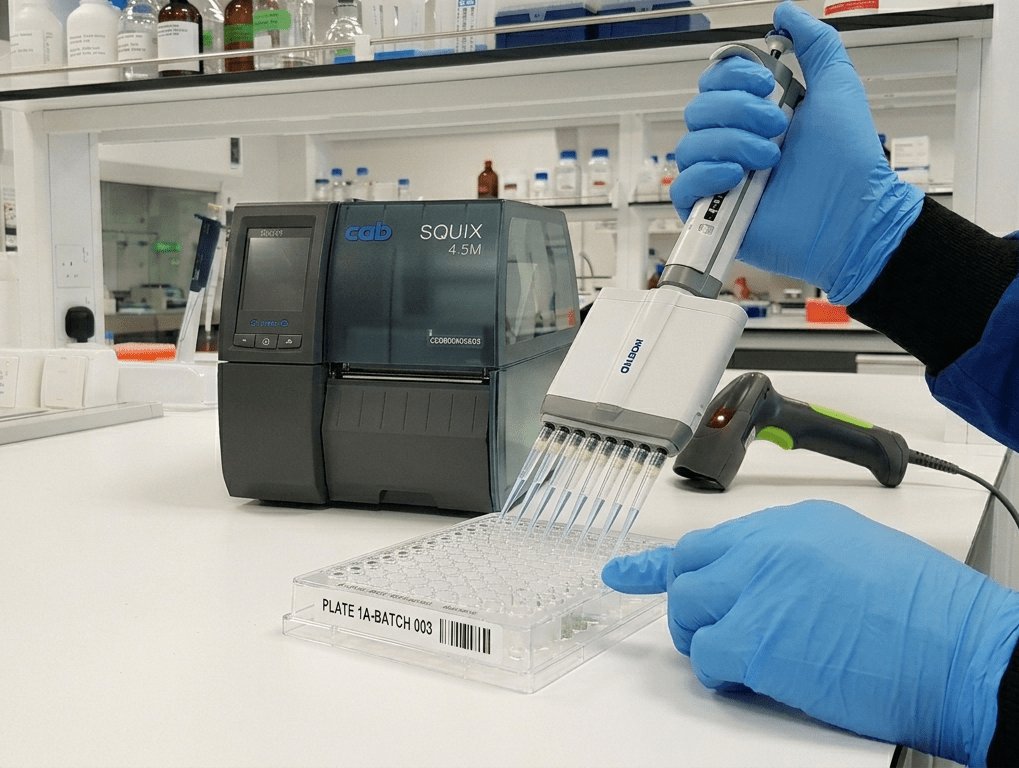
    Print microplate labels as needed using live data from laboratory systems. Generate labels during plate setup, sample loading, or assay preparation, with well IDs, plate IDs, and variable data applied at the point of use. This approach supports workflows where plate data changes frequently or requires immediate, accurate identification.

    A simple setup can integrate real-time labeling directly into your workflow.

    durable labels

    Blank plate labels designed for small formats, flat surfaces, and secure adhesion on plates.

    label printers

    Print high-resolution barcodes and text for plate IDs and sample tracking.

    compatible ribbons

    Thermal transfer ribbons produce durable images resistant to chemicals, moisture, and handling.

    microplate labelers

    Apply labels consistently to plates during setup or automated workflows.

    Print-on-demand labeling fits laboratories that generate or update plate data in real time. This includes screening labs, genomics workflows, and assay development environments where plates are created, modified, and labeled during processing, and where accurate, immediate identification is required.

    Print blood bag labels at collection points.

    Print blood bag labels as needed using live data from blood bank systems. Generate labels during collection, component processing, or labeling steps, with donation identification numbers, product codes, and variable data applied at the point of use. This approach supports workflows where blood data updates in real time and requires immediate, accurate identification.

    A simple setup can integrate real-time labeling directly into your workflow.

    Set up a complete labeling workflow using the right materials and equipment to print and apply labels directly during blood collection, component processing, and blood bank handling workflows.

    durable labels

    Start with blank label stock engineered for flexible PVC blood bags.

    label printers

    Print high-resolution barcodes and text for complex blood label layouts.

    compatible ribbons

    Use included thermal transfer ribbons to produce durable barcode labels.

    label software

    Integrate barcode software to generate ISBT 128 labels and DIN data.

    Print-on-demand labeling fits blood banks and collection centers that generate or update donation data in real time. This includes blood collection sites, processing labs, and transfusion services where blood bags are labeled on demand, and workflows require immediate, accurate identification without relying on pre-printed labels.

    Control blood bag labeling with pre-printed formats.

    Get blood bag labels professionally printed with controlled data, advanced converting, and durable materials. Eliminate in-house printing while ensuring every label meets performance requirements for blood bank use, including handling, cold storage, and transfusion.

    Guarantee no duplicates with professionally printed blood bag labels.

    Pre-printed labeling combines controlled printing, advanced converting, and durable materials to deliver consistent, ready-to-use blood bag labels. This approach removes variability from in-house printing and ensures every label meets requirements for DIN accuracy, barcode performance, and reliable identification across blood bank workflows.

    consistency at scale

    Receive pre-printed labels with guaranteed unique DIN sequences, controlled serialization, and validated data across batches and production runs.

    accurate din formats

    Maintain consistent DIN formats to ensure accurate identification across blood bags, segments, and associated components.

    durable finsihing

    Use engineered label constructions designed to resist edge lift, moisture, and routine handling, helping maintain adhesion and readability throughout blood collection.

    Pre-printed labeling fits blood banks and collection centers that manage high volumes of donations and require controlled, repeatable identification. This includes blood collection sites, processing facilities, and transfusion services where standardized labeling, consistent DIN assignment, and stable data support efficient, validated workflows without frequent changes.

    Support accurate workflows with real-time labeling.

    In laboratory environments, data often isn’t final until the last moment—at the bench, at the instrument, or during sample handling. Printing labels on demand helps ensure each tube or vial reflects the most accurate information, while fitting naturally into the way your work actually happens.

    Support accurate workflows with real-time labeling.

    In laboratory environments, data often isn’t final until the last moment—at the bench, at the instrument, or during sample handling. Printing labels on demand helps ensure each tube or vial reflects the most accurate information, while fitting naturally into the way your work actually happens.

    A simple setup can integrate real-time labeling directly into your workflow.

    In laboratory environments, data often isn’t final until the last moment—at the bench, at the instrument, or during sample handling. Printing labels on demand helps ensure each tube or vial reflects the most accurate information, while fitting naturally into the way your work actually happens.

    compatible ribbons

    Compatible resin ribbons ensuring clear, durable print for barcodes and text

    compatible ribbons

    Compatible resin ribbons ensuring clear, durable print for barcodes and text

    In laboratory environments, data often isn’t final until the last moment—at the bench, at the instrument, or during sample handling. Printing labels on demand helps ensure each tube or vial reflects the most accurate information, while fitting naturally into the way your work actually happens.

    Support accurate workflows with real-time labeling.

    In laboratory environments, data often isn’t final until the last moment—at the bench, at the instrument, or during sample handling. Printing labels on demand helps ensure each tube or vial reflects the most accurate information, while fitting naturally into the way your work actually happens.

    A simple setup can integrate real-time labeling directly into your workflow.

    compatible ribbons

    Compatible resin ribbons ensuring clear, durable print for barcodes and text

    compatible ribbons

    Compatible resin ribbons ensuring clear, durable print for barcodes and text

    compatible ribbons

    Compatible resin ribbons ensuring clear, durable print for barcodes and text

    compatible ribbons

    Compatible resin ribbons ensuring clear, durable print for barcodes and text

    In laboratory environments, data often isn’t final until the last moment—at the bench, at the instrument, or during sample handling. Printing labels on demand helps ensure each tube or vial reflects the most accurate information, while fitting naturally into the way your work actually happens.

    Support accurate workflows with real-time labeling.

    In laboratory environments, data often isn’t final until the last moment—at the bench, at the instrument, or during sample handling. Printing labels on demand helps ensure each tube or vial reflects the most accurate information, while fitting naturally into the way your work actually happens.

    A simple setup can integrate real-time labeling directly into your workflow.

    In laboratory environments, data often isn’t final until the last moment—at the bench, at the instrument, or during sample handling. Printing labels on demand helps ensure each tube or vial reflects the most accurate information, while fitting naturally into the way your work actually happens.

    durable labels

    Durable labels that stay attached through handling, storage, or cryogenic conditions

    compatible ribbons

    Compatible resin ribbons ensuring clear, durable print for barcodes and text

    reliable printer

    Compact, consistent, durable thermal transfer printing at the point of use

    label software

    Label management software to format labels and connect to sample data or LIMS

    In laboratory environments, data often isn’t final until the last moment—at the bench, at the instrument, or during sample handling. Printing labels on demand helps ensure each tube or vial reflects the most accurate information, while fitting naturally into the way your work actually happens.

    Request a quote

    Take advantage of our volume discounts for bulk orders. Reach out to us for a personalized quote tailored to your needs.

    "*" indicates required fields

    This field is for validation purposes and should be left unchanged.